How Do You Judge Amino Acid Hydrolysate Quality Beyond Total Amino Acid Content?
A grower or adviser reading a hydrolysate label often sees one number: total amino acids. Yet two products with the same figure can differ in how much of that material is free amino acids, how much is short peptide and how much is larger, partly intact protein. Judging amino acid hydrolysate quality therefore depends on knowing the split between these fractions, and on the method used to measure it.
Protein hydrolysates are produced by breaking down protein from animal or plant raw materials, either enzymatically or chemically. Free amino acids are single units. Peptides are short chains of linked amino acids. A total nitrogen or total amino acid value does not show how these forms are distributed.
Cropenta Insight
Total amino acid values do not show the free amino acid share or the molecular size of peptides. When assessing a hydrolysate, ask for the analytical method and the reporting basis for each fraction. A label figure read without these details can lead to conclusions about composition that the data cannot support, so comparisons should use results obtained by the same method.
Why the fraction split matters
Total content describes how much material is present, not what form it is in. Research on plant-derived protein hydrolysates points to the molecules present, and not only the total amount, as relevant when interpreting potential activity.[1] That interpretation remains open, meaning growers and advisers need to look beyond total amounts, because the specific fraction responsible for a given plant response is not always identified.
Free amino acids and peptides need separate measurement
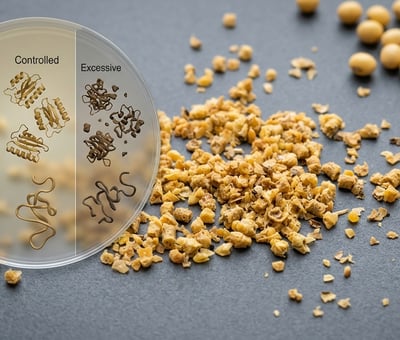
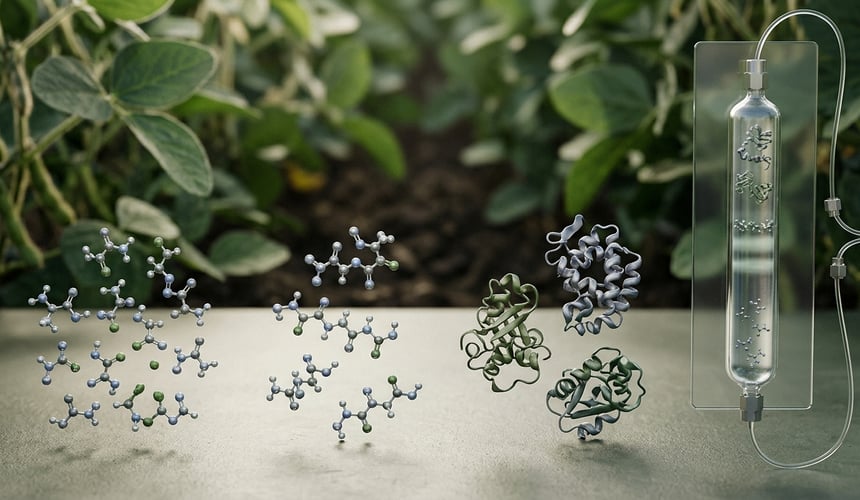
Free amino acids are typically quantified with amino acid analysis after the sample is prepared. Peptide fractions need a different step, such as size-based separation, which shows the molecular weight distribution. Without it, an amino acid bound in a peptide can be counted in the total without being recognized as free. The optical form also matters: plants generally use L-amino acids, so isomer analysis is relevant where D-forms may be present.
What the reported responses do and do not show
In the primary study, a review of amino acid biostimulants and protein hydrolysates, protein hydrolysate was reported to have a positive influence on total root area and root length, which the review discusses in relation to mineral-nutrient and water-use efficiency.[1] These are reported observations from the literature. They do not establish that the same hydrolysate would give the same root response in every crop or growing system, which is why the specific conditions under which results were observed matter when interpreting them.
How the hydrolysis route is discussed in the literature
The hydrolysis route is part of the production process and can be relevant for the resulting composition. Reviews of protein hydrolysate production treat the manufacturing route as a factor in composition and in the plant metabolic effects reported. In one reviewed set of experiments, amino acid application raised chlorophyll a and b by 10 to 25 percent in wheat, while tomato results differed; the conditions of those trials are not detailed here.[2]
What a buyer can ask for when assessing a hydrolysate
Useful questions concern the share of free amino acids, the molecular size distribution of the peptide fraction, the analytical method, the hydrolysis route and the salt and heavy-metal content. Techniques such as HPLC-based amino acid analysis and size-exclusion chromatography are commonly used for this, but a result only has meaning when the method and reporting basis are stated. A quality figure on its own does not establish agronomic performance.
Evidence limits
Trials on protein hydrolysates differ in crop, raw material and growing conditions, and the fraction behind an observed response is not always identified. Results from one hydrolysate or one crop cannot be transferred to another product or species. Chemical composition alone is no evidence of agronomic efficacy.
Technical Summary
Total amino acid figures do not show the fraction split. Free amino acids, short peptides and larger fragments need separate measurement, and the analytical method and reporting basis should be stated. Results from one crop or product do not transfer to others.
This article was created with the help of AI and reviewed by the Cropenta editorial team. It is general information, not professional advice.
Technical Questions
Does a higher total amino acid figure mean a better hydrolysate?
Not necessarily. A total amino acid figure describes how much material is present, not whether it consists mainly of free amino acids, short peptides or larger protein fragments. Two hydrolysates with the same total can differ in these fractions and in their hydrolysis route. Compare the analytical method, the fraction split and the reporting basis before drawing conclusions about plant response.
Why does the isomer form of an amino acid matter when evaluating a hydrolysate?
Amino acids can exist as L- or D-isomers, and plants generally use the L-form. Chemical hydrolysis can convert part of the material into D-forms, which may be less usable by plants and may be a concern at higher levels. Chiral analysis shows the isomer balance, so it is worth asking whether this is reported. The effect of isomer balance on a specific crop still needs crop-specific evidence.
Looking for something specific?
Our team is there to help you find the right raw materials and solutions for your formulations