Understanding Urease Activity in Full-Fat Soybeans
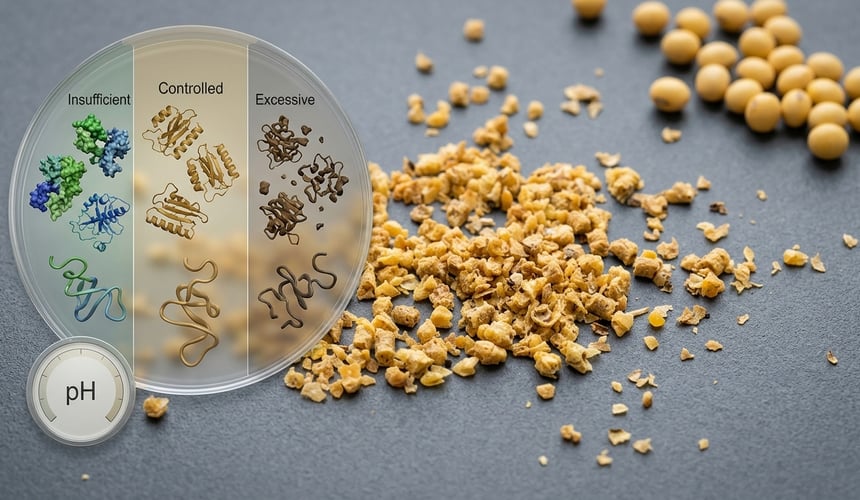
A batch of full-fat soybeans arrives at the processing facility without a comprehensive record of its thermal history. It is unclear whether the processing parameters—such as temperature, moisture, or duration—achieved the desired level of inactivity for anti-nutritional factors. Urease activity is a simple and rapid measurement that is widely used in this context, though it is important to recognize that urease itself is not the primary issue. Rather, it serves as a marker whose inactivation may accompany the degradation of undesirable components such as trypsin inhibitors, for which the plant material is being processed. The usefulness of the test therefore depends on how closely those two inactivation behaviors align under the actual processing conditions.
Cropenta Insight
Urease indicates that heat was applied, not that nutrient quality is assured. A specific result suggests thermal input occurred; it does not confirm protein bioavailability or anti-nutritional factor reduction. A more comprehensive assessment involves correlating urease activity with trypsin inhibitor levels, protein solubility in KOH, or the Protein Dispersibility Index, alongside reactive lysine data where available. In dietary planning, urease often serves as an initial screening checkpoint before further analysis.
Why a urea-splitting enzyme became the industry's heat marker
Raw soybeans contain urease, an enzyme that catalyzes the hydrolysis of urea into ammonia and carbon dioxide. In the assay format used by industry, this reaction raises the pH of a buffered soybean suspension, and the magnitude of that pH rise is proportional to the amount of residual active urease in the sample. The test therefore quantifies enzyme survival rather than the level of anti-nutritional compounds. Urease has become a routine indicator because it shares thermal sensitivity with the trypsin inhibitors and certain lectins present in raw soybeans, and the assay can be executed in standard plant laboratory setups without specialized enzymatic reagents. This practical combination of speed, low cost and general alignment with inhibitor destruction explains its persistence in quality-control programs.
Trypsin inhibitors represent one group of anti-nutritional factors of primary concern in monogastric diets. These compounds interact with pancreatic enzymes such as trypsin and chymotrypsin, and that interaction can restrict protein digestion and prompt compensatory pancreatic enzyme secretion. In livestock, the presence of these inhibitors, along with lectins, is generally associated with the poor performance observed when raw soybean meals are fed. Because both urease and trypsin inhibitors are proteins or protein-like entities, their denaturation upon heating may follow a similar trajectory across a typical processing range, which provides the practical basis for employing urease as a preliminary indicator. That alignment, however, is empirical rather than exact, and it is the central caveat of the method.
The relationship between urease and trypsin inhibitor inactivation
Toasting, extrusion, and roasting are thermal processes employed to denature these factors, but each employs distinct combinations of temperature, moisture content, pressure, and material exposure time. Toasting using steam, dry roasting in a drum, and passage through a die in an extruder represent chemically and physically distinct processes that cannot be assumed to be interchangeable. A toasting line achieving a target moisture content at a given temperature may inactivate trypsin inhibitors at a different rate than a dry roasting line operating at the same thermal reading, and extrusion introduces mechanical shear and pressure components not present in simple roasting.
This variability is critical for interpretation. Urease activity and trypsin inhibitor activity do not decrease in perfect synchronicity across every manufacturing method or moisture setting. Within the parameters of a consistent and controlled operation, however, the correlation is often sufficient for urease to serve as a screening indicator, but it remains a correlation, not a direct identity. The two assays are therefore best considered complementary rather than substitutable. Laboratories equipped to measure trypsin inhibitor activity generally treat it as the more direct metric for confirming sufficient heat application for monogastric species, while urease provides the rapid first look.
What the test cannot see: under-processing, over-processing and protein damage
A low urease reading confirms that the material has reached a level of heat sufficient to degrade that specific enzyme. This finding does not guarantee that the entire thermal process was perfectly executed. The same low result can stem from an appropriate treatment or from a process that was excessively aggressive. Because urease activity typically ceases and does not recover once destroyed, the test lacks an upper boundary alert for instances of over-processing.
Concerns regarding over-processing are relevant. Excessive heat encourages Maillard reactions between available reducing sugars and the epsilon-amino group of lysine, which progressively changes reactive lysine into forms that are less available for use by the animal. Total lysine levels measured in a laboratory analysis may remain stable while the fraction of reactive lysine diminishes, meaning a standard amino acid profile may not identify this degradation. Protein solubility when analyzed in 0.2% KOH is one technique utilized to investigate this: solubility tends to decrease with heat treatment, and an abnormally low reading can suggest over-processing, whereas a high reading might indicate under-processing. It should be noted that KOH solubility is not a direct measure of trypsin inhibitors and should not be interpreted as such. Similarly, the Protein Dispersibility Index operates on a comparable principle within its own designated range and is not interchangeable with urease or KOH solubility.
There is also consideration of species utilization. Ruminants are often noted to exhibit a greater tolerance for unprocessed soy components compared to pigs or poultry because rumen microorganisms can participate in the breakdown of trypsin inhibitors. This context suggests that the significance of urease activity may carry less weight in beef or dairy rations compared to diets for broiler or piglet species. Consequently, the definition of an acceptable processing window is dictated by the intended consumer species, not solely by the assay result.
Meeting the targets when protein quality is the objective
The method of processing influences parameters beyond just anti-nutritional factors. Research observing growing pigs compared extruded versus roasted full-fat soybeans and investigated amino acid and energy digestibility, taking into account the inclusion of a multienzyme supplement containing protease, phytase, and fiber-degrading activity.[1] This work emphasizes that the digestibility outcomes attributable to a specific process are ultimately measured in the animal, rather than being extrapolated solely from a heat indicator. Urease activity was not designed to forecast amino acid digestibility; apparent or standardized ileal amino acid digestibility in swine and poultry, and intestinal digestibility in ruminants, remain the quantifiable metrics for actual nutrient utilization.
For material buyers and nutritional formulators, the logical outcome is the establishment of a tiered specification. Initial screening via urease activity can quickly identify gross instances of inadequate heating. A subsequent measurement of trypsin inhibitor levels then quantifies the remaining anti-nutritional load.[2] KOH protein solubility or the Protein Dispersibility Index checks for excessive thermal exposure. Reactive lysine, if available, detects damage that total lysine analysis might overlook. Urease activity, standing alone, does not confirm optimal processing, and increased heat does not inherently equate to better quality.
Reading a urease result in practice
A high urease value on a full-fat soybean sample serves as a direct signal that thermal treatment was insufficient, making it probable that trypsin inhibitors remain biologically active. This justifies the decision to retain the load pending further action. Conversely, a low value removes the immediate concern related to insufficient processing, but it does not validate the final product for use. Remaining concerns, such as potential damage to lysine or the opening of oil cells, require the application of the other analytical indicators.
Variation from batch to batch in an extrusion or toasting line is expected and is influenced by variables like the initial moisture content of the beans, the processing throughput rate, and the specific operational status of the die or drum. Therefore, the timing of sampling and the testing frequency are as important as the assay used. A urease reading is only as reliable as the specific material sample from which it was derived and the process record it can be cross-referenced against.
Technical Summary
Urease activity functions as an indirect indicator of thermal processing in full-fat soybeans. It quantifies residual enzyme levels, and due to the shared thermal sensitivity of urease and trypsin inhibitors, low readings suggest adequate thermal exposure for monogastric diets. This test is insufficient to detect over-processing, predict amino acid digestibility, or replace assessments made by trypsin inhibitor activity, KOH protein solubility, the Protein Dispersibility Index, or reactive lysine. It should be used as a preliminary screening tool, not as a final approval specification.
This article was created with the help of AI and reviewed by the Cropenta editorial team. It is general information, not professional advice.
Technical Questions
Why do formulators still rely on urease when trypsin inhibitor activity is the more direct measure?
Trypsin inhibitor assays may require specialized enzymatic reagents, stringent standardizations, and a longer turnaround time than is practical for high-volume feed operations. Urease testing requires only simple reagents like a buffer and a pH meter, making it a rapid initial screen. Some practitioners use it to flag questionable loads before submitting them for more complex trypsin inhibitor analysis for final decision-making.
Can two full-fat soybean batches with identical urease values differ in nutritional value?
Yes, it is possible. Urease activity decreases once a certain heat threshold is met but does not show a distinct inflection point to indicate nutrient damage beyond that. Two batches could share the same low urease value, but one may have undergone moderate heating while the other was severely over-processed, leading to differences in reactive lysine content and amino acid utilization that the urease test would miss.
How should processing history influence the reading of a protein quality measurement?
Different processing methods, such as steam toasting, dry roasting, and extrusion, expose the soybean material to varying combinations of moisture, pressure, shear, and time. Because the starting material may be whole beans or processed meal, knowing the specific treatment history and the physical form of the sample is necessary to determine if a urease or solubility reading falls within an expected range for that specific operation.
Where does reactive lysine fit alongside urease in a soybean quality program?
Urease indicates the presence of thermal input. Reactive lysine assessment checks if that thermal input was excessive, as Maillard reactions consume the free epsilon-amino groups on lysine residues, a change not captured by total lysine assays. Together, these metrics establish a profile of the processing, covering both the lack of heat and the presence of damage.
What is the operational difference between using urease and trypsin inhibitor assays for batch release?
Urease functions as a rapid indicator of successful heat application, providing an initial gate check. It indicates the load is not grossly under-processed. Trypsin inhibitor activity quantifies the actual residual inhibition level. Therefore, urease acts as a necessary but insufficient step; it flags the potential issue, while the inhibitor assay confirms the required level of risk reduction.
Looking for something specific?
Our team is there to help you find the right raw materials and solutions for your formulations