How Do Adjuvants Influence Spray Droplet Behavior on Leaf Surfaces?
A droplet leaving a nozzle carries a certain surface tension, a certain momentum and a certain size. What happens in the next few milliseconds depends less on the sprayer than on the liquid's chemistry and the leaf it lands on. That is where adjuvants enter the picture, and why the phrase adjuvant spray performance describes a set of measurable physical events rather than a general impression of coverage.
Cropenta Insight
The behaviour of a droplet on a leaf is decided by the balance between liquid surface tension, the leaf's own surface energy and the additives present. For formulators, that makes raw-material quality and compatibility central: a wetting agent, a surfactant or an amino-acid-based component changes the physical properties of the tank solution, and its behaviour can differ between water sources, pH ranges and co-formulants. Characterising those interactions before scaling up is more informative than assuming any single adjuvant acts the same way in every recipe.
Surface tension and contact angle: the two numbers that govern impact
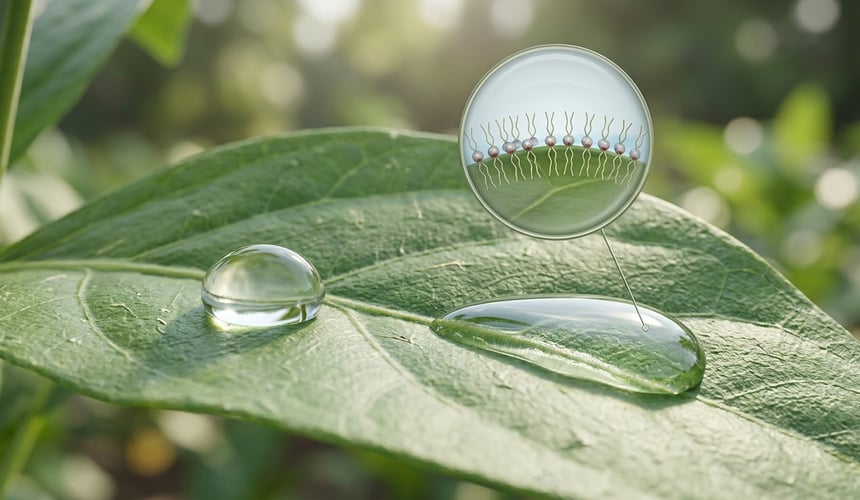
Water has a high surface tension, roughly 72 mN/m at room temperature, which makes it bead up on most leaf surfaces. A surfactant molecule has a hydrophobic tail and a hydrophilic head; it migrates to the air-liquid interface and reduces the force pulling the droplet into a sphere. The result is a lower contact angle, the angle measured where the droplet edge meets the leaf. A smaller angle means the droplet spreads further across the surface.
Non-ionic surfactants generally reduce surface tension without adding charge, while ionic surfactants introduce charge that can interact with other formulation components. That distinction matters because the leaf surface itself is not neutral: the cuticle carries waxes, and some species have more crystalline epicuticular wax than others. A formulation that spreads well on a waxy cabbage leaf may behave differently on a tomato leaf or a cereal blade. Adjuvant addition has also been reported to change the droplet formation process and the resulting droplet size spectrum in controlled spray tests, which in turn affects how much liquid actually reaches and stays on the target [1].
Spreading, retention and the limits of wetting
Better spreading is not automatically better uptake. A droplet that spreads into a thin film covers more area, but the driving force for absorption is the concentration gradient across the cuticle and the permeability of that cuticle to the specific molecule. If the active ingredient is poorly soluble or the cuticle is thick, spreading alone does not carry it through. Wetting agents improve contact between the liquid and the leaf; they do not guarantee that the substance crosses the barrier. This is why a stable, well-spreading formulation can still underperform if the active or nutrient cannot partition into the cuticle.
Retention is a separate question from spreading. A droplet that spreads too far can run off the leaf edge, particularly on near-vertical surfaces. There is a practical balance between reducing surface tension enough to wet the surface and reducing it so far that the liquid loses its grip. The optimal point depends on the crop, the leaf orientation and the application volume.
Leaf surface properties decide the outcome
The leaf is not a passive surface. Cuticular wax composition, trichome density, stomatal distribution and surface roughness all influence how a droplet interacts with it. In the same experimental work, spreading dynamics were reported to vary with leaf surface characteristics, which suggests that adjuvant selection is not universal [2]. Findings from studies on multifunctional adjuvants indicate that the physical and chemical features of the spray solution can be formulation-dependent; these results should not be read as evidence that any adjuvant improves any spray.
Plant nutrition and foliar application continue to be discussed in relation to more precise delivery, and the physical behaviour of the spray is part of that discussion [3]. A formulator who understands the surface tension, contact angle and retention profile of a recipe can make more informed choices than one who selects an adjuvant on the basis of a general wetting claim.
Technical Summary
Adjuvants alter droplet behaviour by reducing surface tension and contact angle, changing spreading and retention on the leaf. The leaf's cuticular waxes and surface structure determine the actual outcome. Better wetting does not automatically mean better uptake, because absorption depends on cuticle permeability and the properties of the dissolved substance. Adjuvant selection is therefore formulation- and crop-specific, not universal.
This article was created with the help of AI and reviewed by the Cropenta editorial team. It is general information, not professional advice.
Technical Questions
Why can a spray with good wetting still show poor nutrient uptake?
Wetting reduces surface tension and contact angle, so the droplet spreads further. Uptake depends on whether the dissolved substance can cross the cuticle, which is governed by cuticle thickness, wax composition and the molecule's properties. Spreading and absorption are separate processes. A formulation may wet a leaf perfectly while the nutrient remains on the surface.
Does a lower contact angle always mean better spray performance?
Not necessarily. A very low contact angle means the droplet spreads into a thin film, which can improve coverage but also increase the risk of run-off on inclined or waxy leaves. The practical optimum depends on leaf orientation, application volume and the target. Extremely low surface tension is not automatically advantageous for retention.
How do water quality and pH affect adjuvant behaviour in the tank?
Water hardness, pH and dissolved ions can interact with surfactant molecules and change their interfacial activity. Ionic surfactants are particularly sensitive to charged species in the water. This means an adjuvant tested in one water source may behave differently in another. Formulators often characterise behaviour across the pH and hardness range relevant to their market before finalising a recipe.
Are non-ionic surfactants always preferable to ionic types?
No. Non-ionic surfactants avoid adding charge, which can simplify compatibility with other formulation components, but ionic surfactants may offer different spreading or retention characteristics on specific leaf surfaces. The right choice depends on the target crop, the co-formulants present and the application conditions. Neither category is universally better.
What leaf characteristics most affect how a droplet behaves on impact?
Cuticular wax composition and structure, trichome density, surface roughness and leaf orientation are the main factors. Waxy leaves with crystalline epicuticular wax tend to repel water more strongly, while hairy or rough surfaces can pin droplets. Because these traits vary between species and even between leaf ages, adjuvant performance data from one crop should not be transferred directly to another.
Looking for something specific?
Our team is there to help you find the right raw materials and solutions for your formulations