Why Glycine Betaine Results Vary Between Fields and Seasons
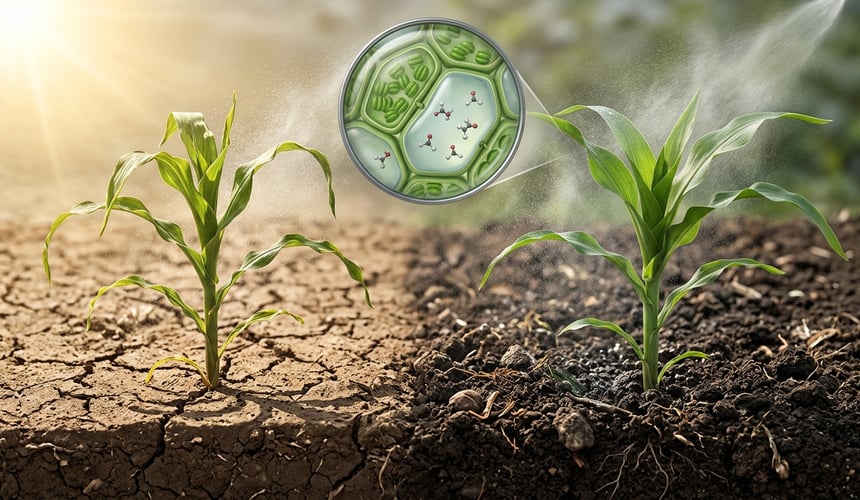
A grower sprays glycine betaine before a forecast heatwave. One block looks unchanged a week later; the neighbouring field, treated the same way, holds up noticeably better. Nothing in the product changed between the two passes. The difference sits in the crop, the stress and the timing.
Glycine betaine is a compatible solute: a small, water-soluble molecule that plants can accumulate in cells without disrupting metabolism. It is one of several osmoprotectants involved in osmotic adjustment, the process by which a plant maintains cellular water balance under drought, salinity or heat pressure. Many species synthesise it naturally; others, including several important crops, accumulate little or none.
Cropenta Insight
Variability is not a failure of the molecule but of matching it to a situation. A crop that already accumulates glycine betaine has less room for an applied effect than one that does not, and a treatment applied after stress has already reduced growth has less to work with. Reading trial results means asking what was stressed, when, and in which species.
Not Every Crop Responds the Same Way
The single largest source of inconsistency is the plant itself. Species differ widely in their natural capacity to accumulate glycine betaine, and that capacity shapes what an external application can add. A recent review of the compound's role in plant stress responses notes that applied glycine betaine has been associated with protection under environmental challenges in a range of studies, but the responses are not uniform across species and conditions[1]. Where a crop already maintains high internal concentrations, the additional effect of a spray may be small or undetectable. Where accumulation is naturally low, the same treatment may show a clearer difference.
Genotype adds a second layer. Within one species, cultivars can differ in stress physiology, leaf wax, rooting depth and stress timing, so two varieties in the same trial can respond differently to identical applications. This is one reason a result from a single variety should not be read as a species-wide conclusion.
What the Stress Was, and When It Arrived
Field trials rarely compare like with like. A treatment tested under moderate, short drought pressure is not the same test as one run through a long salinity episode. The stressor, its intensity and its duration all influence whether osmotic adjustment is the limiting factor at all.
Work on maize under salt stress illustrates the point. In that study, glycine betaine application was linked to changes in the plant's salt response, but the work is specific to maize and to controlled salt conditions[2]. It does not establish that the same application produces comparable outcomes in a saline field, in another crop, or under a different stress.
Timing compounds this. A plant that has already lost leaf area or closed stomata for days has less capacity to translate any cellular benefit into visible growth. Applications made before or early in a stress episode are testing something different from applications made after damage is visible.
Salinity, Species and the Limits of Generalisation
Salinity trials are a useful reminder of how narrow findings can be. A study on four cool-season turfgrass species under salt stress examined growth and quality responses to glycine betaine application, and the outcomes differed between the species tested[3]. That is not a contradiction in the data; it is what species-level variation looks like when it is measured directly. Turfgrass results do not transfer to arable crops, and salinity results do not transfer to heat or drought episodes.
Concentration and application method matter too. Foliar uptake, leaf wetting, adjuvant choice and spray volume all affect how much of the applied compound reaches the tissue, and the optimal window is not the same for every crop.
How to Read a Positive Trial
When a glycine betaine trial reports a benefit, the useful questions are specific: which species and cultivar, which stressor, what intensity, what application timing relative to the stress, and whether the measured outcome was physiological or agronomic. A measurable change in leaf water status is not the same result as a measurable change in harvestable yield, and a greenhouse result is not a field result.
The composition of plant-derived materials also varies with source and processing, which is why betaine concentrations in plant foods are characterised by targeted analytical methods rather than assumed from species labels[4]. Applied products deserve the same scrutiny.
Technical Summary
Glycine betaine consistency in the field is limited by three interacting factors: whether the crop naturally accumulates the compound, which stressor is present and when it is applied relative to that stress, and how the application reaches the tissue. Species and genotype variation, documented in maize and turfgrass studies, means results do not transfer automatically between crops or conditions. Physiological responses should not be read as yield outcomes.
This article was created with the help of AI and reviewed by the Cropenta editorial team. It is general information, not professional advice.
Technical Questions
Does a crop that naturally produces glycine betaine still respond to an applied product?
Possibly, but the margin is often narrower. Species that already accumulate high internal concentrations of glycine betaine have less unmet demand for the compound, so an applied treatment may show little measurable difference. Species with low natural accumulation are more likely to show a detectable response, though this remains crop and condition specific.
Why can two cultivars of the same crop react differently to identical glycine betaine applications?
Cultivars differ in stress physiology, leaf structure, rooting depth and the timing of their stress responses. These differences change how much osmotic adjustment is limiting growth at any given moment. A result measured in one variety should therefore be treated as variety specific rather than as a conclusion for the whole species.
Is a change in leaf water status the same as a yield result?
No. Physiological measurements such as leaf water potential or osmotic adjustment describe what happens inside the plant. Yield and quality are agronomic outcomes influenced by many other factors. A trial that reports only physiological changes does not establish a harvestable benefit, and the two should be kept separate when interpreting results.
How does application timing influence whether a trial shows an effect?
Applications made before or early in a stress episode test the plant's capacity to prepare for stress. Applications made after damage is visible test something different, because lost leaf area and closed stomata limit how much any cellular benefit can translate into growth. Trials with different timing windows are not directly comparable.
- 1.Deciphering the role of glycine betaine in enhancing plant stress tolerance
- 2.Glycine betaine increases salt tolerance in maize (Zea mays L.)
- 3.Effects of glycine betaine application on growth and quality of four cool-season turfgrass species under salinity stress
- 4.Dietary Sources of Glycine Betaine and Proline Betaine in Plant Foods
Looking for something specific?
Our team is there to help you find the right raw materials and solutions for your formulations