How Trials in Living Cows Assess Rumen-Protected Soy Protein
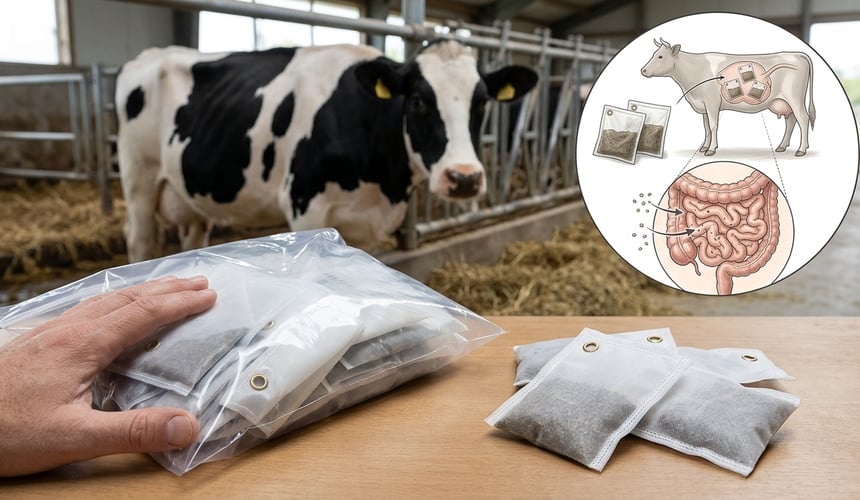
Rumen protection is only part of the picture for a protein source. A specification sheet may state that a protein is largely protected from breakdown in the rumen, but that figure alone does not show how much protein reaches the small intestine and is digested there. In dairy cows, in vivo evaluation, meaning measurement in the living animal, combines several steps and addresses this knowledge gap left by a single protection percentage.
Cropenta Insight
For nutritionists and feed buyers, a protection percentage describes only the share resisting the rumen. The share digested after the rumen matters just as much, so RUP should be read together with intestinal digestibility. The passage rate assumed in the calculation also changes the RUP value, so figures are comparable only at the same rate.
Why lab degradation tests need a check in living animals
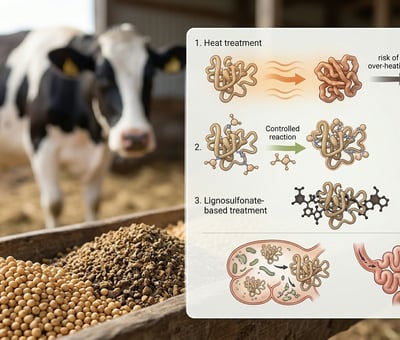
Rumen-protected soy protein is treated so that less of its protein is broken down by ruminal microbes and more passes to the small intestine. Heat, Maillard reactions with reducing sugars and other treatments are used for this. Protection has to be judged together with intestinal digestibility, because over-processing can lower both.
Rumen degradation is often first characterised with the nylon bag method, in which small samples are incubated in the rumen of fistulated cows (cows fitted with a rumen cannula). This is called in situ testing, meaning testing inside the animal. The results are described with fractions for the soluble, washable, potentially degradable and undegradable protein, and a degradation rate per hour. Effective degradation and RUP then depend on an assumed fractional passage rate (Kp), which is estimated from intake and production rather than measured in the bag.
In vitro tests, meaning tests performed in the laboratory with enzymes or chemical fractionation, are cheaper and faster, but they do not always agree with in situ results. For heat- and Maillard-protected proteins they may overstate rumen protection.[1] A 2022 study by Y Zhang compared in situ and in vitro evaluation of coated rumen-protected products, not soy protein, and found that ruminal disappearance and gastrointestinal release varied with the coating prototype and retention time.[2]
Measuring what reaches the small intestine
The next step is to measure what happens after the rumen. In the mobile nylon bag technique, bags holding the rumen-undegraded residue are placed into the digestive tract of cows fitted with duodenal cannulas, and recovered after passage. The share of the residue that disappears in the small intestine gives the intestinal digestibility. A high RUP with low intestinal digestibility delivers little usable protein, so the two values must be read together.
Amino acid supply is the practical question behind these measurements. Microbial protein synthesis in the rumen supplies a large part of the amino acids a cow absorbs, so bypass protein adds value only on top of what the microbes already provide. Trials therefore also consider how much microbial protein is produced, which is usually estimated separately from the bypass measurements.
Nitrogen use and the valuation step
Nitrogen utilisation links the rumen and the intestine. Protein that is degraded too fast in the rumen can exceed what the microbes can capture, and the excess nitrogen is lost in urine, which is one reason milk urea is used as an indicator in ration work. Values derived from in situ and digestibility measurements are then translated into formulation systems such as the Dutch DVE/OEB, the German nXP/RNB, INRA PDI or CNCPS metabolisable protein. These systems differ in their assumptions, so a valuation is a calculation, not an animal result.
According to the manufacturing partner, Bypass Soy Protein MP, a product offered by Cropenta, is documented with a calculated RUP above 80% at an assumed passage rate of 6%/h and an intestinal digestibility of the rumen-undegraded protein close to 100%. These documented values should be checked against the underlying data before use in formulation, as the cited sources do not describe the specific trials behind them.
Understanding the limits of in vivo characterization
The in situ and digestibility measurements characterise an ingredient. They do not show how much milk a cow produces when the ingredient is fed, and none of the sources cited here reports a milk production result for protected soy protein. The 2022 study by Zhang concerns coated protected products rather than soy protein, so its findings describe coating and retention effects in general, not soy protein specifically.[2] Studies of soybean peptides in vitro and in vivo examine a different product form, so their findings do not transfer directly to this ingredient.[3, 4] This article does not compare protected products with one another, which would require an independent comparative source beyond its scope.
What a feed buyer should ask for in an in vivo dataset
Buyers reviewing an in vivo protein dataset should ask for three values read together: RUP at a stated passage rate, intestinal digestibility of that RUP, and the valuation system used to convert them. A dataset giving only the first number leaves usable protein unknown, and RUP values at different passage rates cannot be ranked against each other.
Technical Summary
RUP is meaningful only when read with its assumed passage rate and with intestinal digestibility. In vivo evaluation combines in situ degradation measurements, intestinal digestibility steps and formulation valuation. In vitro results may overstate rumen protection for heat- and Maillard-treated proteins, so in situ data from living cows give a fuller picture before ingredients are compared in ration formulation work.
This article was created with the help of AI and reviewed by the Cropenta editorial team. It is general information, not professional advice.
Technical Questions
Why does the assumed passage rate change the RUP value of a protected protein?
RUP is calculated from degradation fractions and an assumed fractional passage rate, which is estimated from intake and production rather than measured in the nylon bag. A faster assumed passage rate leaves less time for degradation in the rumen, so the calculated RUP is higher. Values calculated at different passage rates therefore cannot be compared directly, and the passage rate should be stated with every RUP figure.
Can an in vitro degradation result replace an in situ value for a Maillard-treated soy protein?
Not for formulation purposes. In vitro tests can be useful for screening, but for heat- and Maillard-protected proteins they may overstate rumen protection compared with in situ measurements in rumen-fistulated cows. Declared values based on in vitro methods are not directly comparable with in situ values, so the method behind any protection figure should be checked before ingredients are compared.
- 1.An evaluation of the validity of an in vitro and an in situ/in ... - PMC - NIH
- 2.In situ and in vitro evaluation of the bioavailability of rumen-protected ...
- 3.In vitro and in vivo Studies of Soybean Peptides on Milk Production ... - PMC
- 4.In vitro and in vivo Studies of Soybean Peptides on Milk Production, Rumen ...
Looking for something specific?
Our team is there to help you find the right raw materials and solutions for your formulations