Why moisture content decides heat treatment effectiveness in full-fat soybeans
Two batches of full-fat soybeans can leave the same toaster at the same temperature, with the same residence time and the same urease value on the release sheet, and still perform differently in the feeder. The difference often sits in a number that never appears on the process sheet: the moisture content of full-fat soybeans at the moment of heat treatment. Water is the medium that carries heat into the cotyledon, and it decides whether the applied heat inactivates the trypsin inhibitors or starts binding lysine.
Three moisture figures matter, and they are not interchangeable. Incoming moisture is what the raw bean brings from harvest, drying and storage. Process moisture is what steam or liquid water adds at the inlet of a toaster or extruder, plus what the material picks up inside. Residual moisture is what remains in the cooled product and affects storage stability. Only the second determines how well the heat treatment works.
Cropenta Insight
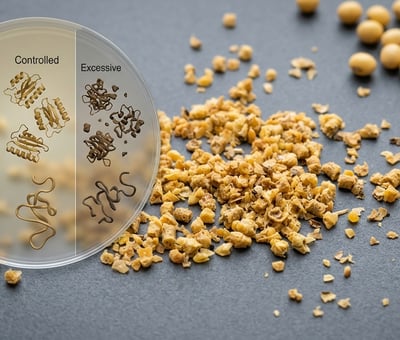
Moisture decides which side of a heat treatment a batch lands on. Enough water in the bean lets heat unfold and inactivate the trypsin inhibitors at a moderate temperature; too little pushes the operator towards more temperature and longer time, and dry heat can brown a bean while inhibitor activity stays high. Too much water combined with too much heat moves the reaction towards Maillard products and bound lysine. Routine indicators record the outcome, not the moisture history behind it.
Why moisture content in full-fat soybeans decides how heat treatment works
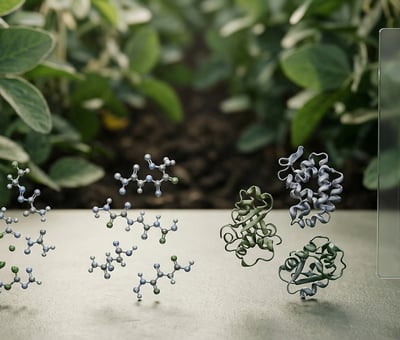
Heat has to travel into the cotyledon. Steam condenses on the cooler surface of the bean and releases latent heat; inside an extruder barrel, water in the mash conducts heat and lubricates the material as it moves. Water also acts as a plasticiser: it loosens the tightly folded globular structure of the storage proteins and lowers the temperature at which they unfold. That is decisive, because the trypsin inhibitors are proteins themselves and their inactivation is a denaturation event. The Kunitz inhibitor loses activity relatively easily; the Bowman-Birk inhibitor is more heat-stable and needs heat together with moisture before it stops binding trypsin. Lectins and other heat-labile factors follow the same principle, while oligosaccharides and antigenic proteins are far less affected by heat.
Lysine pays the bill when moisture and heat overshoot
Water does more than carry energy; it mobilises reducing sugars such as glucose and fructose in the bean matrix. Mobile sugars can react with the free epsilon-amino group of lysine, through a Schiff base and Amadori rearrangement products, and eventually into brown melanoidins. The early steps are nutritionally mild, the later ones are not: lysine becomes bound and unavailable. Total lysine can stay almost unchanged on the analysis sheet while reactive lysine falls. Low KOH protein solubility and a low Protein Dispersibility Index indicate that the same process has gone far, although they measure water- and alkali-soluble protein, not trypsin inhibitors. In ruminant rations a limited degree of this binding is used deliberately, since protein that escapes rumen fermentation can still be released further down the tract; pushed further, the reaction costs intestinal digestibility as well.
Variety and incoming grain moisture move the optimum
Heat treatment is often evaluated without reference to the raw material it is applied to. A study that combined different soybean varieties with different heat treatments found that both factors shaped the outcome, and that excessive heat reduced nutrient digestibility, particularly of protein [1]. Varieties differ in composition and do not respond identically to the same heat load, so one toaster setting cannot be optimal for every delivery.
Upstream drying belongs to the same picture, even though drying is not toasting and not extrusion. Research on soybean grain drying indicates that air temperature and grain moisture interact: drying at 40 °C with grain at 12 % moisture preserved quality better, whereas higher temperatures and 14 % moisture were associated with greater acidity and more grain defects [2]. A lot that arrives wetter and more damaged enters the toaster or extruder in a different state from the previous one, which is why a fixed recipe for the process tends to drift.
What the release tests show, and what they leave out
Urease activity is the cheapest routine check. A low value shows that heat was applied, not that processing was optimal, and it says nothing about lysine lost on the way. Trypsin inhibitor activity is the more direct indicator for monogastrics and is the one that responds to the moisture question, since urease is inactivated over a broad window and the two indicators do not necessarily move together. KOH protein solubility and the Protein Dispersibility Index flag over-processing. Reactive lysine captures Maillard damage specifically. None of these tests records the moisture at which the batch was treated, so two deliveries with identical urease values can have travelled very different routes.
Amino acid digestibility measured in animals remains the reference. A review of heat treatment and soy protein properties describes several routes by which processing changes digestive behaviour [3]. In vitro models are useful for ranking and screening: recent work on full-fat soybeans of different origin and thermal history reported differences in protein secondary structure, in vitro digestion kinetics and predicted standardised ileal digestibility [4]. Predicted values are a guide, and a change in protein structure or solubility does not by itself demonstrate a higher amino acid supply.
Where moisture content in full-fat soybeans is controlled on the line
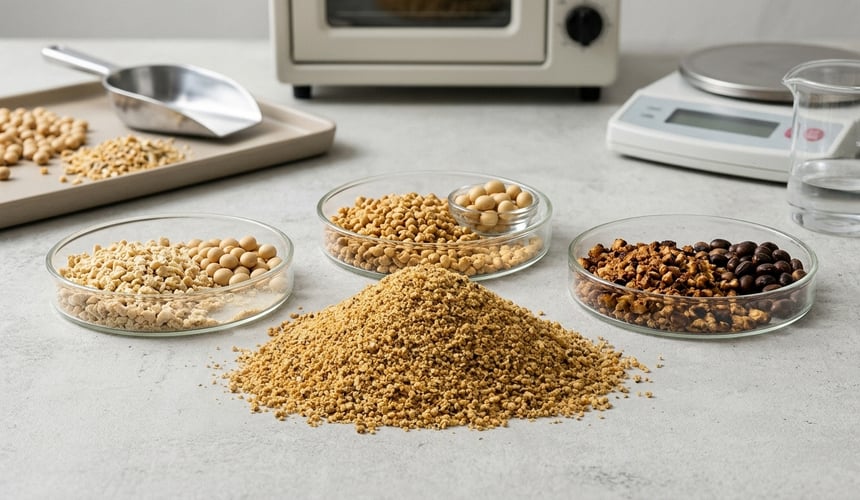
Control begins with measurement frequency: incoming moisture varies between deliveries and within a silo, so a weekly value is a weak basis for a process setting. In extrusion, water is a process variable as much as a nutritional one. Raising moisture in the barrel tends to lower melt viscosity and changes how much mechanical energy the screws transfer to the material, which in turn affects die pressure and expansion; adjusting water to protect lysine without touching screw speed or throughput simply moves the process to a different operating point, sometimes with more fines and a less even product. In toasting, steam addition, drum temperature and residence time are the levers, and the bean needs holding time for water to equilibrate through the cotyledon. Water that stays on the surface leaves a batch over-processed outside and under-processed inside. Record moisture, temperature, time and throughput as one set.
Technical Summary
Moisture content determines how effectively heat inactivates heat-labile anti-nutritional factors and how much protein is damaged in the same operation. Water conducts heat, plasticises storage proteins and enables denaturation of trypsin inhibitors at moderate temperatures; dry heat can colour a bean without finishing that job. Excess moisture with excess heat promotes Maillard binding of lysine. Urease alone cannot confirm adequate processing, and no routine indicator records the moisture at which a batch was treated.
This article was created with the help of AI and reviewed by the Cropenta editorial team. It is general information, not professional advice.
Technical Questions
Why can two full-fat soybean batches with the same urease activity differ in nutritional value?
Urease is an indirect heat indicator that falls over a broad temperature range. Two batches can reach the same urease value along different routes, for example one with high process moisture at moderate temperature and one with dry heat at higher temperature. Those routes differ in how far trypsin inhibitor activity fell and how much reactive lysine was bound, and urease records neither of those outcomes.
Does more process moisture always mean better protein quality in extruded full-fat soybeans?
No. Water helps unfold and inactivate the heat-labile proteins and helps heat travel through the cotyledon, but higher moisture in an extruder barrel also changes melt viscosity, mechanical energy input and die pressure. Combined with generous heat, extra water moves the reaction towards Maillard products. The useful range is process specific and has to be judged with trypsin inhibitor activity, reactive lysine and, ideally, amino acid digestibility.
Which measurements should accompany moisture data when heat-treated full-fat soybeans are assessed?
Trypsin inhibitor activity is the most direct heat-labile indicator for monogastrics. Reactive lysine shows Maillard damage, while KOH protein solubility and the Protein Dispersibility Index indicate how far protein has been made insoluble, each with its own range. Urease is a cheap screen only. Amino acid digestibility measured in pigs or poultry is the value the formulation ultimately depends on.
How does incoming grain moisture from drying affect later toasting or extrusion?
Drying conditions set the state of the raw material. Work on soybean grain indicates that moderate drying temperature with grain at around 12 % moisture preserved quality better than higher temperatures with 14 % moisture, which were associated with greater acidity and more grain defects. A wetter, more damaged lot enters the toaster or extruder differently and may need a different setting.
- 1.Interaction of Soybean Varieties and Heat Treatments and Its Effect on ... (F. Hemetsberger et al., 2021)
- 2.Effects of drying temperature and moisture content of soybeans grains ... (P. da Silva Silva et al., 2026)
- 3.Current insights into heat treatment for improving functionalities of soy ... (Comprehensive Reviews in Food Science and Food Safety)
- 4.Full-fat soybean origin and thermal processing affect protein secondary structure, in vitro digestion kinetics, and predicted standardized ileal ...
Looking for something specific?
Our team is there to help you find the right raw materials and solutions for your formulations