How to check microbial biostimulant claims beyond marketing
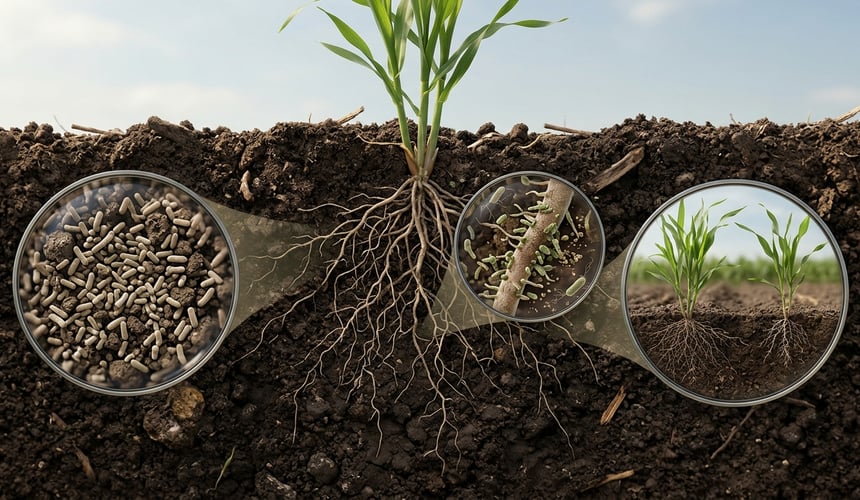
A product label may state that a microbial biostimulant is associated with root activity or with crop responses under drought pressure. The question for a grower is what sits behind that sentence. A high count of living microorganisms tells you only one thing. It does not show whether those organisms keep their intended function after application, or whether the crop responds in the field.
Cropenta Insight
For growers and advisers, the most useful distinction is that survival, activity and field effect are separate evidence steps. Survival shows that organisms are present and alive; activity shows that they keep a relevant function; only field data under comparable conditions can speak to a crop-level outcome. Interpreting microbial biostimulant claims starts with asking which of these steps a document actually covers.
Three separate evidence steps
Microbial biostimulant claims are easier to assess when three questions are kept apart. The first is survival: do the organisms remain viable through production, storage and application? The second is activity: do they still perform the function the claim describes, such as nutrient mobilization or root-zone activity? The third is field effect: is a crop response documented under real cultivation conditions? A positive answer to the first question does not establish either of the others.
A recent review frames microbial biostimulants as a response to current agricultural needs, but an overview of this kind does not replace product-level data.[1] Plant biostimulants are broadly defined as substances or microorganisms applied to support nutrition efficiency, abiotic stress responses or crop quality traits.[2] That breadth is one reason claims vary so widely, and why the wording of a claim should be read closely.
Why viable counts and lab results fall short
A viable count shows that organisms were alive when they were measured. It says nothing about whether they colonize roots, compete with the native soil microbiome, or respond to the soil chemistry they meet after application. Soil pH, organic matter and existing microbial communities all shape what happens next. Lab activity under controlled conditions does not necessarily show the same activity in a field with variable temperature and moisture.
Published principles for justifying plant biostimulant claims point in the same direction: the evidence should match the specific claim being made.[3] A result observed with one organism does not automatically apply to every product built on it, because the specific isolate, formulation and carrier can change the outcome.
What to check in published data and trials
Start with the trial conditions. Note the crop, the growing system and whether results came from the laboratory, the greenhouse or the field. Check whether the control was untreated or treated with a reference product, whether the trial was replicated across sites and seasons, and whether the measured outcome is a physiological measurement, such as leaf chlorophyll or root measurements, or a production outcome such as yield. Results from one season, one site or a single supplier-run trial deserve caution.
Survival data should be tied to shelf life and handling. Activity data should be tied to the function named in the claim. Field data should come from the same crop and conditions the grower works with. Supplier claims should be read as the company's own statements, not as independent validation.
Prebiotic, probiotic and synbiotic: what the terms mean
In agriculture, a probiotic product contains living microorganisms applied to the plant or its root zone. A prebiotic is a substrate that selectively supports microorganisms already present in the soil or introduced with a product. A synbiotic combines both. Each component of such a combination requires its own evidence. Prebiotic support, survival and crop response are separate steps and should not be assumed from one another.
What the evidence does and does not show
The cited review and framework documents give general context rather than data on specific products. Where a product's documentation offers only general framing, the evidence for that product has to come from its own documented trials. Evidence across crops, products and conditions is uneven, and a positive laboratory result is not a field result.
Technical Summary
Microbial biostimulant claims should be assessed in three steps: survival, activity and field effect. Viable counts and lab activity address only the first two. Crop-level statements need replicated field data under comparable conditions, with clear controls and attributed sources.
This article was created with the help of AI and reviewed by the Cropenta editorial team. It is general information, not professional advice.
Technical Questions
Why is a high viable count not enough to judge a microbial biostimulant?
A viable count shows that organisms were alive at the time of measurement. It does not show whether they colonize roots, persist in the soil, compete with the native soil microbiome or keep the function named in the claim. Those points need separate activity and field data under realistic conditions.
What should a grower look for in a field trial summary?
Look for the crop, the growing system, the number of sites and seasons, and an untreated or reference control. Check whether the measured outcome is a physiological response or a production outcome. Trials run by the supplier should be read as company-reported data and compared with independent results where they exist.
Looking for something specific?
Our team is there to help you find the right raw materials and solutions for your formulations