How In Vitro Methods Measure Rumen Degradation and Intestinal Digestibility of Soy Protein
A nutritionist comparing two batches of treated soybean meal is usually looking at one number: how much crude protein escapes the rumen. That number, the rumen-undegradable protein or RUP fraction, is calculated from degradation measurements, not from the protein left after a full incubation. Soybean meal degrades quickly in the rumen, so the practical question is how much of it reaches the small intestine and how much of that protein the cow can actually use. The answer depends on which laboratory method produced the value, and the methods do not agree.
Cropenta Insight
Degradation kinetics and intestinal digestibility answer different questions, and neither alone describes protein value. A slow degradation rate means little if the undegraded fraction is poorly digested in the small intestine, and a high intestinal digestibility figure is irrelevant when most of the protein was already fermented in the rumen. Formulators who keep both measurements, at the same assumed passage rate, avoid the most common misreading of protected soy protein data.
What in vitro degradation tests actually measure
In vitro protein degradation tests are laboratory simulations. Feed samples are incubated with rumen fluid or with proteolytic enzymes under controlled temperature and pH, and the release of soluble nitrogen or amino groups is followed over time. Some protocols instead fractionate the protein by solubility, dividing it into rapidly soluble, washable and slowly degradable pools. From these data, a degradation rate is fitted and an effective degradation is calculated.
The limitations matter more than the procedure. Rumen fluid is a mixed, living population, and its activity varies with donor diet and time of sampling. Enzymatic and solubility-based tests simplify a complex microbial process, and the correlation with in-situ measurement in rumen-fistulated cows is generally poor. For heat-treated and Maillard-protected proteins the deviation is systematic: these methods tend to overstate rumen protection, sometimes by tens of percentage points. A declared RUP value based on an in vitro method is therefore not comparable with one derived from nylon-bag incubation.
Rumen degradation kinetics and the passage rate problem
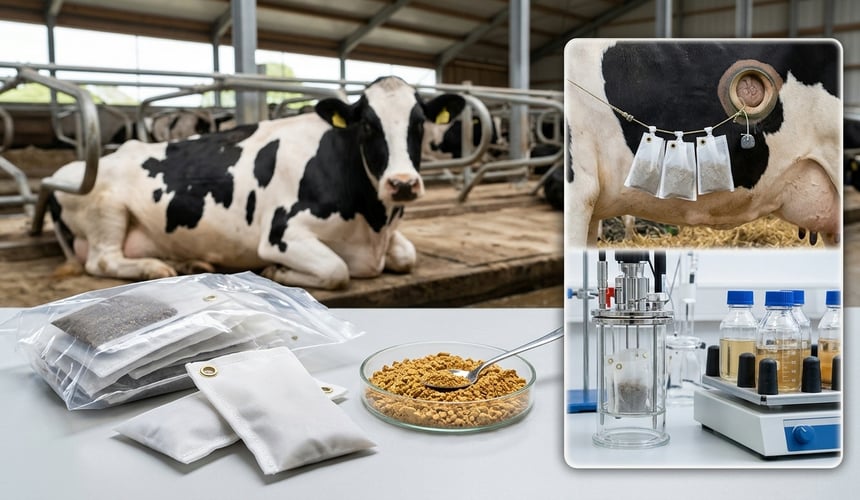
The in-situ nylon-bag method remains the reference for characterising degradation. Ground sample is placed in polyester bags and incubated in the rumen of fistulated cows, and disappearance of nitrogen is measured over a series of time points. The result is a set of fractions: S, the soluble fraction; W-S, washable but insoluble; D, the potentially degradable fraction; U, the undegradable fraction; and Kd, the fractional degradation rate per hour.
RUP is not what remains in the bag at the end of incubation. It is calculated from D, Kd and Kp, where Kp is the assumed fractional passage rate. Kp is estimated from dry matter intake and production level; it is not measured in the bag. This is why two RUP values can only be compared at the same Kp, and why a figure quoted without its passage rate is incomplete. In practice, Kp values between 5 and 8 percent per hour are common in dairy formulation, and the calculated RUP shifts with each assumption.
Microbial protein synthesis sets the other boundary. Rumen micro-organisms build protein from degradable protein, ammonia and fermentable energy, and that microbial protein supplies a large share of the amino acids reaching the small intestine. Extra bypass protein only adds value where microbial protein and the basal ration leave a gap in metabolisable protein.
Intestinal digestibility and the mobile nylon bag technique
Escaping the rumen is only half the story. Intestinal digestibility is the share of the rumen-undegraded protein that is digested in the small intestine, and it is measured with the mobile nylon bag technique in cows fitted with duodenal cannulas. Bags containing the rumen-undegraded residue are inserted into the duodenum, recovered from the faeces, and the disappearance of nitrogen is calculated.
Values are reported as rounded percentages. A high RUP combined with low intestinal digestibility delivers little usable protein, which is the central weakness of any single-number evaluation of protected soy protein. Over-processing illustrates the trap: heat and Maillard reactions can make protein resistant to rumen micro-organisms, but taken too far they also reduce intestinal digestibility and destroy reactive lysine, the lysine with a free epsilon-amino group that remains available for digestion. Total lysine can stay unchanged on a laboratory report while reactive lysine falls.
Turning measurements into formulation values
Measured degradation and digestibility are experimental characterisation. Nutritional protein valuation is a separate step: systems such as the Dutch DVE/OEB system, the German nXP/RNB system, INRA PDI and CNCPS metabolisable protein translate those measurements into formulation values. These are calculations, not animal results, and the values differ between systems and between assumed passage rates.
For soy protein this distinction is practical. Untreated soybean meal is extensively degraded in the rumen and contributes mainly rumen-degradable protein, producing a strongly positive rumen protein balance. Treated soybean meal shifts the balance toward RUP, but the size of that shift depends on the treatment, the method used to measure it and the Kp assumed in the calculation. Rations carrying excess rumen-degradable protein tend to show higher milk urea, so the crude protein share and the protein balance of the ration are steered together rather than by RUP alone.
When evaluating a protected soy protein, ask three questions in sequence: which method produced the degradation data, at what assumed passage rate was RUP calculated, and what is the intestinal digestibility of the undegraded fraction? Only then does the value mean something in a ration.
Technical Summary
In vitro tests estimate rumen degradation but correlate poorly with in-situ results for heat- and Maillard-protected soy protein, often overstating protection. RUP is calculated from degradation rate and an assumed passage rate, so values are comparable only at the same Kp. Intestinal digestibility of the undegraded fraction, measured with mobile nylon bags, determines usable protein. Formulation values from DVE/OEB, nXP, PDI or CNCPS are calculations, not animal outcomes.
This article was created with the help of AI and reviewed by the Cropenta editorial team. It is general information, not professional advice.
Technical Questions
Why can two laboratories report different RUP values for the same treated soybean meal?
RUP is calculated from degradation rate and an assumed passage rate, and laboratories may assume different Kp values. In vitro and in-situ methods also diverge, especially for heat-protected proteins. A RUP figure is only meaningful when the method and the passage rate are stated alongside it.
Does a slow rumen degradation rate guarantee good protein value?
No. Slow degradation only describes how much protein escapes the rumen. The undegraded fraction still has to be digested in the small intestine. A protein that resists rumen breakdown but passes through the intestine largely undigested supplies little usable amino acid, so both measurements are needed.
How does over-processing show up in protein quality data?
Advanced Maillard reactions bind lysine through its epsilon-amino group, so total lysine may look normal while reactive lysine falls. Intestinal digestibility of the undegraded fraction typically declines at the same time. Analysing reactive lysine alongside digestibility gives a clearer picture than crude protein or RUP alone.
Where does microbial protein fit when evaluating bypass soy protein?
Rumen micro-organisms produce microbial protein from degradable protein, ammonia and fermentable energy, and it supplies a substantial part of the amino acids reaching the small intestine. Additional bypass protein is only useful when the ration leaves a gap in metabolisable protein after microbial protein is accounted for.
- 1.In vitro and in vivo Studies of Soybean Peptides on Milk Production, Rumen Fermentation, and Ruminal Microbial Flora in Dairy Cows
- 2.In vitro rumen fermentation and protein protection of canola and soybean meal with condensed tannin extract
- 3.Effect of tannins and drying methods on in vitro dry matter and crude protein degradability of soybean meal
Looking for something specific?
Our team is there to help you find the right raw materials and solutions for your formulations