Why the Same Silicon Product Behaves Differently Across Crops
A grower applies the same silicon product to rice and to tomato. Rice shows the treatment in tissue analysis within weeks, the tomato hardly at all. A neighbour reports the opposite experience with a different product on the same two crops. Silicon is silicon, and yet the response is not. The explanation lies less in the label than in the chemistry that happens between the bottle and the root surface.
Cropenta Insight
Silicon behaviour differs fundamentally between crops because uptake capacity, transporter activity and tissue demand vary by species. Manufacturers and formulators therefore cannot rely on a single silicon source to deliver consistent results across a portfolio. Understanding how monomers behave under dilution and in the presence of calcium or bicarbonate helps set realistic expectations for a formulation before it reaches the field.[1]
One absorbable form, many routes to the root
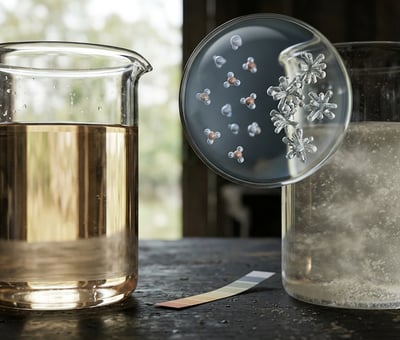
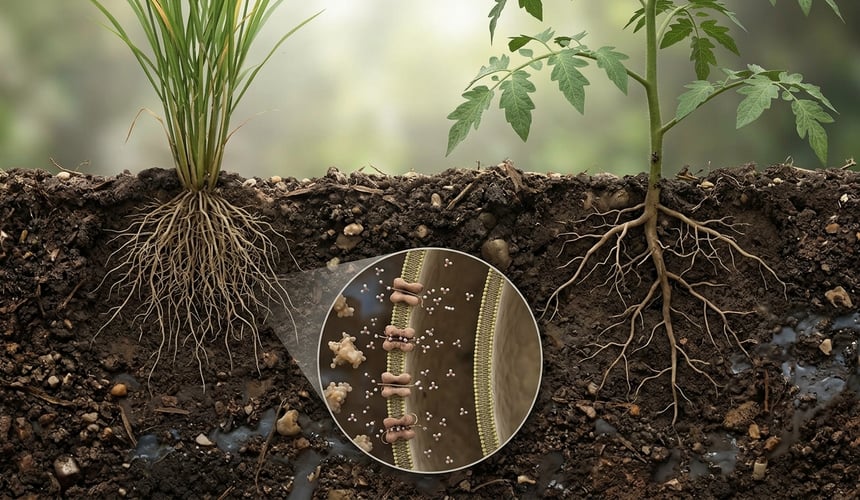
Plants do not take up silicon as an element or as silicate salt. The only form that crosses the root membrane is monosilicic acid, also called orthosilicic acid, Si(OH)4, a small uncharged molecule. Uptake runs through dedicated transporters, Lsi1 for influx and Lsi2 for efflux towards the xylem.[1] The Lsi1 channel is highly selective for the monomer, so any silicon that has already condensed into larger units is effectively outside the uptake pathway until it depolymerises. The concentration of monomeric silicic acid in soil solution rarely exceeds about 2 mmol/L, which is close to the solubility limit of amorphous silica in water. Above that level silanol groups condense into siloxane bonds, forming dimers, oligomers and eventually colloidal silica. That polymerisation is fast and, in practice, hard to reverse.
Species differences are not a detail
The reason rice and tomato respond differently is largely genetic. Luyckx and colleagues describe wide variation in transporter expression and in root-to-shoot transport between species, from strong accumulators such as rice and wheat to low accumulators such as tomato and many dicots.[2] In strong accumulators, silicon is loaded into the transpiration stream and deposited as amorphous silica in cell walls and trichomes; in low accumulators, uptake can be passive and much of the monomer stays in the root apoplast. Pavlovic and coworkers describe interactions with essential and beneficial elements in which silicon can influence nutrient availability in the rhizosphere and root uptake through mechanisms that are still not fully resolved, but with clear species dependence.[1] A product that performs well in one crop is therefore not evidence that it will perform in another, and a soluble form guarantees no agronomic effect by itself.
What silicates and stabilised forms actually deliver
Potassium silicate dissolved in water releases silicate ions, but at the pH of a spray tank or fertigation solution most of that silicon is not present as the monomer. The same applies to stabilised products on the market: a formulation can carry a higher concentration in the bottle, but after dilution to a normal use solution the 2 mmol/L limit applies again, and the equilibrium shifts towards aggregated silica. This is a practical, chemical constraint rather than a marketing point, and it explains why some products reach the root in a more absorbable state than others. Calcium and bicarbonate in the water source can accelerate the shift further.
Environment shifts the balance
Silicon accumulation in crops is also sensitive to the growing conditions. Greger and colleagues reviewed how silicon influences soil availability and accumulation of mineral nutrients, with distinct effects in silicon accumulators such as wheat and maize compared with other species.[3] Transpiration drives the flow that carries monomeric silicic acid to the shoot, so water-limited cultivation, saline irrigation and high-radiation environments can all change how much silicon ends up in the tissue. The underlying effect on stress physiology is documented in review literature, but the specific response depends on species, silicon source and the timing of application.[4]
Reading trial data with the right lens
The practical conclusion is not that one form is universally preferable. It is that the form delivered to the root, the species in front of you and the water chemistry in the tank determine what the plant can actually take up. Monosilicic acid is the biologically relevant molecule; silicate salts and stabilised formulations have to release it before uptake can occur. When comparing silicon sources, ask which form reaches the root under the conditions used, and whether the crop has the transporter machinery to move it any further.
Technical Summary
Silicon enters plants only as monomeric silicic acid via Lsi1 and Lsi2 transporters, and polymerisation above roughly 2 mmol/L removes silicon from the absorbable pool. Accumulation patterns vary widely between strong and weak accumulator species, and environmental factors such as transpiration and water chemistry modulate what reaches the shoot.
This article was created with the help of AI and reviewed by the Cropenta editorial team. It is general information, not professional advice.
Technical Questions
Why can potassium silicate and a stabilised silicic acid product behave differently in the same tank?
Potassium silicate delivers silicate ions whose equilibrium shifts towards polymerised silica once the solution is diluted to typical use strength. A stabilised monosilicic acid product can carry more silicon in the bottle, but after dilution the same 2 mmol/L solubility limit applies. The form that reaches the root, not the label concentration, determines what the plant can absorb.
Does a strong silicon accumulator response in rice tell us anything about tomato or lettuce?
Not directly. Rice and wheat express silicon transporters at high levels and load large amounts of silicic acid into the transpiration stream, while tomato and many dicots rely more on passive uptake and retain less in shoot tissue. Trial results from one species should not be transferred to another without evidence from that species.
How do irrigation water chemistry and transpiration affect silicon accumulation in crops?
Calcium and bicarbonate in the water source can accelerate the shift of monomeric silicic acid towards aggregated silica, reducing what is available at the root surface. Once absorbed, silicon moves largely with the transpiration stream, so water-limited or high-radiation conditions change how much silicon reaches the shoot tissue.
What does 'silicon source efficacy' actually mean in a formulation context?
It refers to how much silicon reaches the root in absorbable, monomeric form under realistic tank or fertigation conditions. A high silicon content on the label describes the bottle, not the spray solution. Compatibility with calcium, pH and dilution strength are the factors that determine whether the monomer survives the journey.
Looking for something specific?
Our team is there to help you find the right raw materials and solutions for your formulations