How Seaweed Extracts Influence Photosynthesis and Carbon Assimilation Under Stress
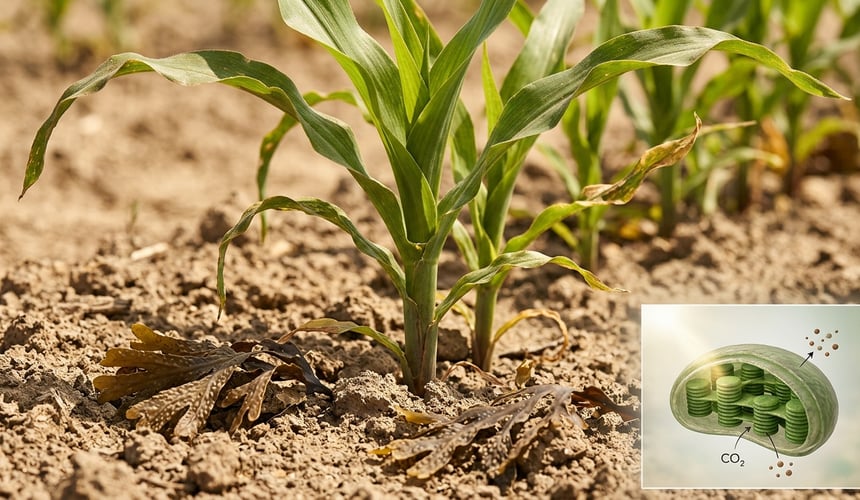
When drought or heat sets in, the first visible sign in many crops is not wilting but a quiet slowdown in photosynthesis. Stomata close to conserve water and the internal CO2 concentration falls; heat damages the light-harvesting apparatus and the enzymes that fix carbon. The result is a growing gap between the light energy a leaf captures and the energy it can actually use, which can leave the plant running below its photosynthetic capacity even after the weather improves. The practical question is whether a seaweed extract, applied as a foliar or root treatment, can influence these processes so that carbon assimilation holds up better while the stress lasts.
Cropenta Insight
The key distinction for buyers and agronomists is between an extract that supplies nutrients and one that changes the plant's own stress response. The physiological effects described in the literature depend on specific bioactive fractions, not on a generic seaweed content. That is why two extracts from the same species can behave differently in a trial, and why label claims should be read against the conditions under which the material was tested.
What Seaweed Extracts Contain and How It Reaches the Leaf
The most studied source in this field is Ascophyllum nodosum, a brown alga whose extracts contain marine polysaccharides such as laminarin and fucoidans, alginic acid, the sugar alcohol mannitol and a range of polyphenolic compounds. These fractions are not all equal in their biological activity. When an extract is applied to foliage, the plant takes up or perceives specific components that can act on signaling pathways rather than simply being metabolized as a nutrient source. For that reason, an extract that is rich in one group of compounds may show a different effect on photosynthesis than a material with a different composition, even if both are sold as seaweed extracts.
Where Seaweed Extracts Touch the Photosynthetic Machinery
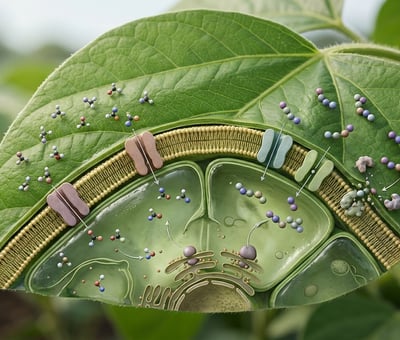
A recent review examining the physiological and molecular evidence for seaweed extract effects on photosynthesis identifies two broad sites of action: the light reactions and the downstream carbon-fixation steps [1]. On the light-reaction side, the evidence points to effects on chlorophyll stability and on the efficiency with which absorbed light energy is converted, sometimes described through chlorophyll fluorescence parameters such as the quantum yield of photosystem II. In experiments with seaweed extract treatments under both mild and severe stress, quantum yield values were reported to be 7 to 18 percent higher than in untreated plants [2]. That is a physiological signal, not a yield measurement, and it indicates that the extract was associated with a better capacity to keep the photosynthetic apparatus working under stress conditions in that trial.
On the carbon-assimilation side, the review points to possible effects on the enzymes of the Calvin cycle and on the regulation of stomatal behavior, which together influence how much CO2 reaches the chloroplast and how efficiently it is fixed [1]. In a cotton study, seaweed extract treatment was associated with reduced stress damage alongside changes in water use and photosynthesis [3]. These observations help explain how a seaweed treatment could be linked to carbon assimilation, but they also show why the effect should be framed as a physiological response under specific conditions rather than as a guarantee of field performance.
Antioxidant Capacity and Oxidative Stress Under Heat and Drought
Photosynthesis is particularly vulnerable to oxidative stress because the light reactions generate reactive oxygen species when the balance between light capture and carbon fixation is disturbed. Under drought and heat, that imbalance becomes more likely. Some seaweed extract fractions, especially polyphenolic compounds and certain polysaccharides, have been associated with changes in the plant's antioxidant status, which may help limit oxidative damage to chloroplast components [1, 2]. This is one of the more direct routes by which an extract could influence chlorophyll stability and light-reaction efficiency during stress.
The effect, however, depends on the stress and the crop. Salinity, drought and heat do not act through identical mechanisms, and results in one species or under greenhouse conditions should not be assumed to hold in another species or in the field. The same caution applies to the choice of extract: a result obtained with a particular commercial product does not establish that all extracts from the same seaweed species will behave the same way.
What the Evidence Means for Practical Decisions
A physiologically detectable change in quantum yield or chlorophyll stability is not the same as a yield increase, and the sources used here mostly report physiological and biochemical measurements under controlled or semi-controlled conditions. The link between those measurements and the economic outcome of a crop depends on many other factors, from water management to timing of application and the severity of the stress. Where trials report changes in photosynthesis and water use alongside reduced stress damage, as in the cotton study [3], the signal is consistent with the proposed mechanisms, but it is not a promise of improved production in every field.
For growers and advisers, the useful takeaway is that seaweed extracts can be assessed by the physiological traits they are intended to influence, and that extract composition and tested conditions matter as much as the seaweed species on the label. A recent study on seaweed extract and amino acid fertilizers notes that such biostimulants can be associated with rapid changes in photosynthetic efficiency and nutrient uptake [4], which supports the idea that some effects may appear within a relatively short time of application. That short-term response is distinct from long-term stress recovery, and the two should not be confused when judging trial results.
Technical Summary
Seaweed extracts, particularly from Ascophyllum nodosum, contain polysaccharides, mannitol and polyphenols that can influence chlorophyll stability, light-reaction efficiency and the enzymes of carbon fixation under stress. Reported quantum yield increases of 7 to 18 percent and associated changes in water use and antioxidant status are physiological findings from specific trials. They do not establish yield gains, and effects vary with species, extract composition and stress conditions.
This article was created with the help of AI and reviewed by the Cropenta editorial team. It is general information, not professional advice.
Technical Questions
Why do trials report quantum yield changes rather than yield changes?
A quantum yield change is a fluorescence-based measure of how efficiently photosystem II converts absorbed light into chemical energy. It can change without the plant fixing more carbon overall, so it should be treated as an indicator of photosynthetic apparatus condition rather than as a production result.
Does the seaweed species alone determine the effect on photosynthesis?
Not necessarily. The reviewed mechanisms depend on specific polysaccharides, polyphenols and other fractions. Two extracts from the same species can differ in composition and therefore in their effect on stress-related physiology, so product-specific evidence remains necessary.
Are the mechanisms the same under drought and heat stress?
Drought closes stomata, reduces the internal CO2 supply and creates an imbalance that can damage the light reactions. Heat affects proteins and enzyme complexes more directly. The pathways overlap, but results from one stress condition are not automatically valid for the other.
- 1.Enhancement of plant photosynthesis by seaweed extracts under optimal and stress conditions. Espinosa-Antón et al., 2026
- 2.Improving Photosynthetic Efficiency and Biochemical Adaptations in plants under stress conditions. 2026
- 3.A seaweed extract-based biostimulant improves cotton productivity under stress conditions. 2024
- 4.The effects of seaweed extract and amino acid fertilizers on growth and photosynthetic efficiency. Saleh et al., 2026
Looking for something specific?
Our team is there to help you find the right raw materials and solutions for your formulations