Do All Seaweed Biostimulants Work the Same? How Algal Species Shape Crop Response
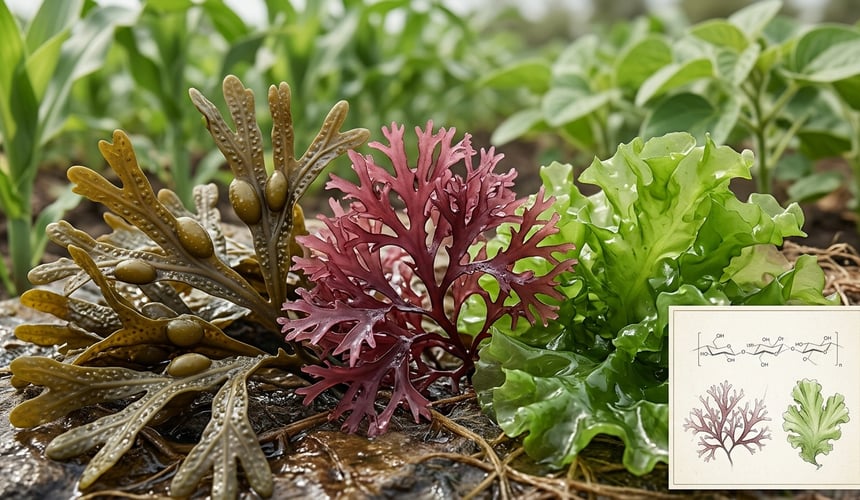
Walk through a trial plot or a greenhouse bench and the question comes up quickly: a seaweed product was applied and the crop looked different, but was that the seaweed, the crop, or the weather? Part of the answer lies in the alga itself. Seaweed biostimulants are made from brown, red or green species, and each group builds a different set of polysaccharides and small molecules. Studies summarised in a recent review of seaweed extracts report, in general terms, better nutrient acquisition and growth in treated plants.[1] Those effects are not uniform across extracts, and the species of origin is one reason why.
Cropenta Insight
For growers and advisers, the practical question is whether a seaweed biostimulant is a fixed input with predictable effects or whether its behaviour depends on the alga it comes from. The evidence points to the second. Brown, red and green seaweeds carry different dominant compounds, so two products described as seaweed extracts can differ in composition. Results from one species or one commercial extract should not be transferred to other species or products without direct data.
Different algae, different compound profiles
Brown algae, including the kelps and rockweeds most often used in commercial extracts, are rich in alginic acid, laminarin, fucoidans and mannitol. Red algae are dominated by carrageenans and agars, while green algae are characterised by ulvans. These polysaccharides and sugar alcohols define each group, and they are not interchangeable. Polyphenolic compounds also vary between species and are often discussed as a separate fraction.
Why the same extract can behave differently
Because the compound profiles differ, the physiological activity may differ as well. Brown algal fractions such as laminarin and fucoidans are commonly discussed in relation to cell wall and signalling processes. Mannitol is an osmotically active sugar alcohol that some plants also produce naturally. Red and green algal polysaccharides have been studied less consistently across crops, so their role is less clear. Reviews describe seaweed effects as the combined result of several bioactives, including minerals such as potassium, calcium and magnesium, rather than a single compound.[2]
What the evidence does and does not show
Seaweed extracts are associated with changes in nutrient uptake and plant growth in several crops. However, most studies do not compare brown, red and green species side by side under identical conditions, so a species effect has not been established for most crop and condition combinations. Physiological changes, such as shifts in nutrient status or root activity, are not the same as yield gains. A response measured in a controlled setting also does not automatically appear in a field crop.
Results from one species cannot be assumed for another, and results from one commercial extract do not prove the performance of all extracts from the same alga. Composition may also vary between batches of raw algae, which is why the species name alone does not fully describe a product.
Practical reading of the evidence
For a grower or adviser, the useful distinction is between the seaweed species, the compounds it contains and the crop outcome actually observed. A brown algae product tested on one crop under one set of conditions says little about a green algae product on another crop. When evaluating a product, the seaweed species, the extract type and the trial conditions are the first details to check.
Technical Summary
Seaweed species differ in their dominant polysaccharides and minerals, so brown, red and green extracts can have different compound profiles. Reported responses to seaweed extracts, including effects on nutrient uptake and growth, vary by species, extract, crop and condition. Physiological changes are not proven yield gains, and the species effect remains incompletely studied.
This article was created with the help of AI and reviewed by the Cropenta editorial team. It is general information, not professional advice.
Looking for something specific?
Our team is there to help you find the right raw materials and solutions for your formulations