Does Hard Spray Water Change How Foliar Nutrients Are Taken Up?
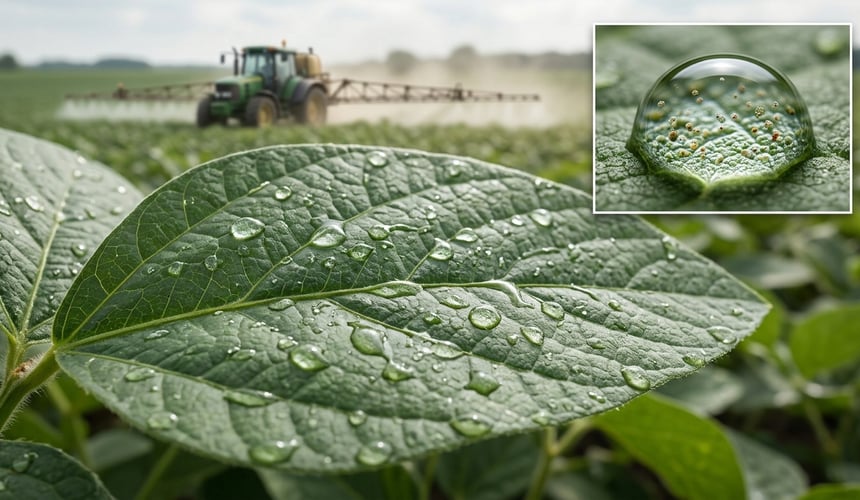
A spray tank that looks clear can still give uneven results in the field, and water quality is one of the first things growers and advisers check. Whether the hardness of spray water affects how much foliar nutrient the leaf takes up is a question the reviewed sources do not answer directly. The link is often discussed in relation to tank chemistry, but it has not been demonstrated in the sources reviewed here, so the gap is worth understanding before changing a spray programme.
Cropenta Insight
Tank compatibility and leaf uptake are separate questions. A mix can look stable in a container while the amount of nutrient available after droplets dry on the leaf remains unmeasured. Record water hardness and pH for each water source, and note which products are combined in each tank. Compare a clear jar test with a small field check on a few plants, and record compatibility and crop response as separate observations.
What hardness means in a spray tank
Water hardness refers to the amount of dissolved calcium and magnesium in water, often reported alongside bicarbonate. General solution chemistry describes how these divalent ions can form combinations with some anions, but the reviewed sources do not measure how this happens in a spray tank with a specific mix. Whether such combinations change the nutrient available to a leaf has not been demonstrated here.
Why this matters on the leaf
A foliar nutrient must move from a drying droplet on the leaf surface into the leaf, passing through the cuticle or stomata. Uptake from the surface is a recognised challenge in crop production, and efficacy depends on many factors besides the nutrient itself.[1] The reviewed sources do not measure how drying droplets on different leaf surfaces affect nutrient availability in hard water. Whether hardness changes uptake for a given nutrient, droplet or crop has not been demonstrated.
What the research does and does not show
The most directly relevant primary study in this set addressed foliar water uptake and the recovery of leaf water potential under acute water deficit. It did not measure dissolved nutrients or water hardness, so its findings cannot be transferred to calcium, magnesium or nutrient ions.[2] No study in the reviewed set compares hard and softened spray water on the same foliar product and crop.
Practical checks before spraying
Because the evidence is limited, the most useful step is to know your water. Measure hardness and pH before adding products, and follow the mixing sequence stated on each product label. Observing whether a mix turns cloudy or forms sediment in a clear container is a compatibility check only. Dissolved stability and agronomic performance are different properties, so a clear jar does not confirm crop response. Any pH adjustment should be judged against the specific ingredients in the mix rather than applied as a general rule.
What remains open
Field trials comparing hard and softened water for the same foliar product, with uptake measured in the leaf, would show whether tank observations relate to crop response. Until such data are available, hardness is best treated as a variable to check, not a confirmed cause of poor response.
Technical Summary
Hardness-related interactions in the tank have not been demonstrated to reduce the soluble nutrient available for leaf uptake. The mangrove study reviewed addresses foliar water uptake and water potential, not nutrient uptake from hard water. Check water hardness, pH and mix compatibility, and treat hardness as a variable to test rather than a confirmed cause.
This article was created with the help of AI and reviewed by the Cropenta editorial team. It is general information, not professional advice.
Technical Questions
Does a clear spray mix in the tank guarantee that the leaf will take up the nutrient?
No. A clear mix shows physical compatibility at the time of mixing, which is a different property from agronomic effectiveness. Dissolved stability says little about what happens after droplets dry on the leaf. The reviewed sources do not provide measurements of leaf uptake from hard versus softened water, so a clear tank test should be read as a compatibility check only.
Is lowering the pH of hard spray water always the right fix?
Not necessarily. A lower pH can keep some calcium and magnesium compounds more soluble, but it is not universally better. The right pH depends on the nutrients, the adjuvants and the other ingredients in the mix, and an acidified mix can behave differently from the same mix in softer water. Adjustments should be checked with a small compatibility test before application, because no reviewed source established a pH target for hard-water foliar sprays.
Looking for something specific?
Our team is there to help you find the right raw materials and solutions for your formulations