Comparing Stability of Monosilicic Acid, Oligomeric Silicic Acid, and Silicates
Why does a silicon product that looks clear in the container sometimes leave a haze after dilution in the spray tank? The answer lies in how silicon behaves in water, which is less simple than a label suggests. Plant roots take up silicon mainly as monosilicic acid, a small uncharged molecule written as Si(OH)4, but that form does not stay in solution indefinitely.[1]
Monosilicic acid, oligomeric silicic acid and silicates differ in how many silicon units they contain and in the pH at which they remain dissolved. Those differences decide how much silicon remains in a form plants can take up.
Cropenta Insight
For growers and advisers, the practical question is less whether a silicon source is soluble and more how much silicon is still dissolved as monosilicic acid once the product reaches the spray tank or irrigation line. Dilution, pH and the presence of calcium or bicarbonate can all shift that balance. Solubility on a label does not by itself establish an agronomic effect, and results from one crop or system should not be assumed for others.
How monosilicic acid behaves in solution
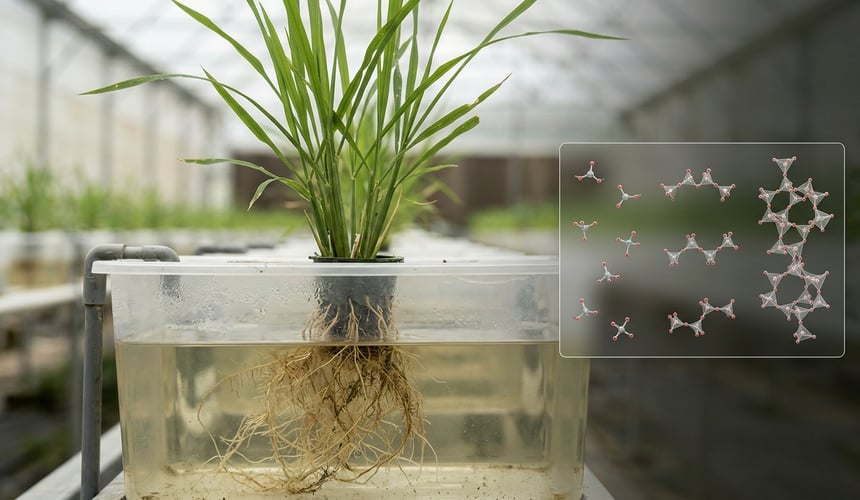
Monosilicic acid is the dissolved monomer. At neutral pH, textbook solubility allows it to stay dissolved only up to about 2 mmol/L, which is only a few tens of milligrams of silicon per litre. Above that level, silanol groups condense into siloxane bonds, forming dimers, oligomers and eventually polymeric and colloidal silica. Once polymerization is well advanced, it is generally regarded as hard to reverse by dilution alone.
Solution pH also matters. In a hydroponic study on lettuce, the nutrient solution was kept between pH 5.5 and 6.5 to support the stability and uptake of monosilicic acid.[2] That result describes one crop grown in a controlled system, not a general rule for all crops or spray conditions.
Oligomeric silicic acid and silicates
Oligomeric silicic acid consists of small chains of silicic acid units, formed once condensation has already started. It sits between the monomer and larger colloidal particles, so its behaviour depends on how far condensation has progressed. Silicates, such as potassium silicate, are salts of silicic acid. They are alkaline, and higher concentrations remain dissolved mainly at high pH. When such a solution is diluted to a near-neutral use solution, silicon can condense again, leaving a smaller share as monosilicic acid than the concentrate suggested.
Stabilised forms are marketed to keep silicon dissolved at higher concentrations. This is a manufacturer claim that the sources reviewed for this article do not verify. Those sources also do not compare silicate and stabilised silicic acid forms across crops, so their relative availability to the plant cannot be concluded from them.
What happens once silicon enters the plant
Silicic acid moves with the transpiration stream to target tissues, where it polymerizes into biogenic silica, often deposited on an organic matrix.[3] The chemistry of the solution is therefore only the first step. Silicon accumulation also differs between crops. Rice and other strong accumulators do not represent all plants, and a soluble form alone does not guarantee an agronomic effect.
What the reader can conclude
Where a product's silicon has largely condensed into colloidal silica after dilution, the monomeric fraction available for root uptake may be small. That fraction is rarely shown on labels. Whether it matters agronomically in a given crop remains an open question in the sources reviewed.
Technical Summary
Monosilicic acid is the dissolved form plant roots are generally associated with taking up, and at neutral pH it stays in solution mainly up to about 2 mmol/L. Oligomeric silicic acid and silicates are transitional or alkaline forms that condense as concentration and pH change. Stabilised labels describe the concentrate, not necessarily the silicon left after dilution. Crop, system and pH data must be considered before assuming agronomic effects.
This article was created with the help of AI and reviewed by the Cropenta editorial team. It is general information, not professional advice.
Technical Questions
Why does the monosilicic acid fraction matter more than the total silicon content on a label?
Total silicon on a label measures all silicon in the concentrate, including fractions that may already have condensed into oligomers or colloidal silica. Plant roots are generally associated with taking up the monomeric form, so the share that remains monomeric after dilution is the more relevant measure. The sources used for this article do not describe a routine method to determine that share, so it is difficult to judge from a label alone.
Does a clear, fully dissolved silicon solution guarantee a response in the crop?
No. Clarity shows that no visible precipitate is present, but it does not show how much silicon is monomeric or whether a given crop takes it up under the conditions at hand. The lettuce study cited here was carried out under specific conditions, and its results should not be transferred to other crops, systems or product types without further evidence.
Looking for something specific?
Our team is there to help you find the right raw materials and solutions for your formulations