How In Vivo Trials Characterize Rumen-Protected Soy Protein Value
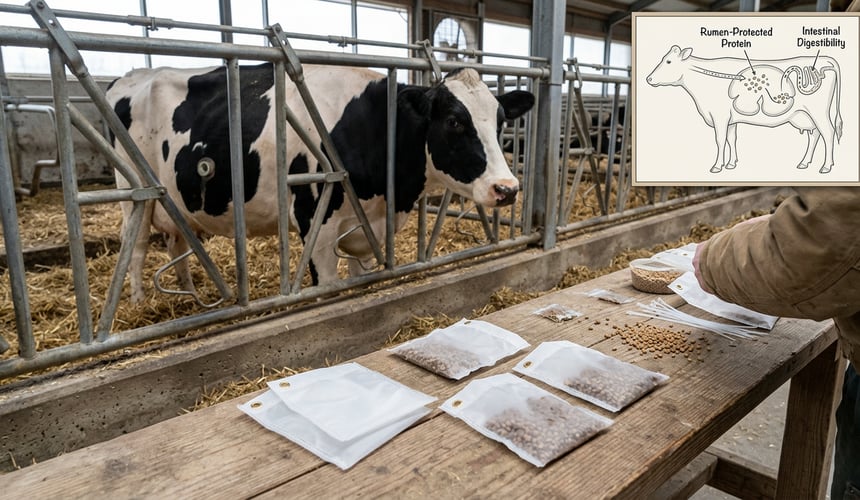
A bypass protein value on a specification sheet looks like a single number. Behind it sits a cow with a rumen cannula, a series of nylon bags pulled at fixed hours, and an assumed passage rate that quietly shapes the outcome. When a nutritionist asks how much soybean protein actually escapes the rumen and how much of that fraction the small intestine can use, the honest answer is that this is measured in living animals, not calculated from a laboratory digest.
In vivo rumen-protected soy protein work therefore splits into two measurements that are often confused with each other: rumen degradation kinetics, which determine the rumen-undegradable protein (RUP) fraction at an assumed passage rate, and intestinal digestibility, which determines how much of that RUP the cow can actually absorb.
Cropenta Insight
The gap between a declared protection figure and a usable protein value usually sits in the method behind it. Degradation measured in rumen-fistulated cows and degradation estimated from an in-vitro digest are not the same quantity, and no conversion factor between them is universally valid. A formulation value is therefore only as informative as the protocol that produced it, the passage rate assumption behind it and the intestinal digestibility that accompanies it.
What the Nylon Bag Measures and What It Does Not
In-situ incubation is the reference approach for protein degradation in ruminant feed evaluation. Ground feed is sealed in polyester bags, placed in the rumen of a fistulated cow and removed after intervals ranging from a few hours to several days. Nitrogen disappearance over time is fitted to a kinetic model: a soluble fraction (S), a washable but insoluble fraction (W-S), a potentially degradable fraction (D), an undegradable fraction (U) and a fractional degradation rate (Kd) per hour. The determination of ruminal degradability of crude protein and starch is one of the most common ways to characterise feed ingredients for ration work [1].
The critical step is the passage rate. Kp, the fractional rate at which digesta leaves the rumen, is not measured in a bag; it is estimated from dry matter intake and production level. Effective degradation and RUP both follow from D, Kd and Kp, which means a RUP percentage is meaningless without the passage rate it was calculated at [1]. A RUP figure quoted at one assumed passage rate cannot be set beside a figure quoted at another, because the two describe different calculation conditions rather than two estimates of the same quantity. Comparing RUP figures across products at different assumed passage rates is one of the most common errors in ingredient comparison.
In-situ work in rumen-fistulated cows characterises the ingredient. It is not a feeding trial, and no milk production outcome follows from it.
Intestinal Digestibility: The Second Half of the Equation
A high RUP figure says nothing about whether the escaping protein can be digested. That requires a second measurement. The mobile nylon bag technique uses cows fitted with duodenal cannulas: rumen-undegraded residues are enclosed in small bags, inserted into the duodenum through the cannula and recovered in the faeces, and the disappearance of nitrogen between insertion and recovery gives the intestinal digestibility of the RUP fraction.
The combination matters more than either number alone. Protein that resists rumen degradation but also resists abomasal acid and small-intestinal enzymes contributes little usable amino acid and adds nitrogen to the faeces. Over-processing is the relevant concern with heavily heat-treated soybean meal: Maillard chemistry that binds lysine into forms the animal cannot release has been described as a proposed mechanism behind reduced amino acid availability in heat-damaged protein sources, although the extent to which it limits digestibility in any specific batch is not established by that mechanism alone [2].
Why Protection Chemistry Decides Which Method Is Trustworthy
Rumen protection is a treatment of a protein source so that less of it is degraded by rumen micro-organisms and more reaches the small intestine. Heat, Maillard reactions with reducing sugars, lignosulfonate treatment and historically formaldehyde are the routes used. In a controlled Maillard reaction, reducing sugars such as glucose, fructose or xylose react with free amino groups, notably the epsilon-amino group of lysine, through Schiff base and Amadori products towards melanoidins. Controlled, this makes protein resistant to rumen micro-organisms while abomasal acid and pepsin, trypsin and chymotrypsin still release amino acids. Excessive, it destroys lysine and lowers digestibility.
This chemistry is exactly why in-vitro degradation tests need to be interpreted with care for protected soybean meal. Enzymatic and fractionation methods and in-situ measurement in fistulated cows do not track each other closely, and for heat- and Maillard-protected proteins the two methods have been reported to diverge further. Declared values based on in-vitro methods are therefore not interchangeable with in-situ values: the two are different measurements, not two estimates of the same quantity.
Reactive lysine is a practical check on over-processing. Total lysine can remain unchanged on a laboratory report while reactive lysine, lysine with a free epsilon-amino group available for digestion, falls. Composition and heat indicators do not replace a digestibility measurement in animals; they only flag where a closer look is warranted [2].
Where Supplemental Protein Studies Sit Alongside This
Feeding trials answer different questions. A study with lactating dairy cows given soybean peptides examined milk production, rumen fermentation, the ruminal bacterial community and blood parameters, with a basal diet and neutral detergent fibre digestibility consistent between treatment groups [3, 4]. Cows receiving the supplement differed in milk yield, but that outcome reflects a whole-animal response to a supplement, not a characterisation of a protected protein fraction. Such trials can support amino acid and nitrogen utilisation arguments, and reviews of ruminant nitrogen conversion note that supplementing rumen-protected essential amino acids can improve nitrogen efficiency in some cases, with better nitrogen utilisation reducing urinary nitrogen [2]. None of that substitutes for measuring degradation and intestinal digestibility directly.
Keeping the two apart matters in practice. Degradation and digestibility measurements are experimental characterisation of an ingredient. The formulation values derived from them (DVE/OEB in the Dutch system, nXP/RNB in the German system, INRA PDI, CNCPS metabolisable protein) are nutritional valuations: calculations that translate measured data into ration numbers. Values differ between systems and between assumed passage rates because the calculations differ. A valuation is not an animal result.
What This Means When You Read a Specification
Several questions sort a well-characterised protected soy protein from a well-worded one. Was degradation measured in fistulated cows under a defined protocol, with the official rumen reference sample included as a control? Was RUP reported together with the passage rate it was calculated at and together with the intestinal digestibility of the RUP fraction? Was intestinal digestibility measured in cannulated cows, or inferred?
Two further points belong in the assessment. First, a high RUP does not by itself indicate good intestinal digestibility; the two are separate measurements and must be read together. Second, microbial protein synthesis sets a ceiling on what extra bypass protein can contribute: rumen micro-organisms build protein from degradable protein, ammonia and fermentable energy, and that microbial protein is a major amino acid source. Bypass protein is complementary to that supply, not a replacement for it.
The evaluation of a protected soy protein is therefore a chain: in-situ degradation kinetics in living cows, a stated passage rate, intestinal digestibility through duodenal cannulas, and only then a formulation value. Where a source reports non-significant or contradicting results, that belongs in the record too. A RUP figure alone tells you where the protein exits the rumen; it does not tell you what the cow receives.
Technical Summary
In vivo characterisation of rumen-protected soy protein combines in-situ nylon bag incubation in rumen-fistulated cows with the mobile nylon bag technique in duodenal-cannulated cows. RUP is calculated from degradation kinetics at an assumed passage rate, so it is only comparable at the same Kp. A high RUP value together with low intestinal digestibility delivers little usable protein, and in-vitro degradation methods and in-situ measurements cannot be treated as interchangeable when heat- and Maillard-treated soybean meal is assessed.
This article was created with the help of AI and reviewed by the Cropenta editorial team. It is general information, not professional advice.
Technical Questions
Why does the assumed passage rate change a RUP figure so much?
Kp is not measured in the bag; it is assumed from intake and production level. A faster assumed passage rate leaves rumen micro-organisms less time to degrade protein, so the escaping fraction rises. Two products with identical degradation rates can therefore show different RUP values purely because different Kp values were used in the calculation.
Can an in-vitro degradation test replace in-situ measurement for protected soybean meal?
The two are separate measurements rather than estimates of one quantity. Enzymatic and fractionation tests and in-situ results in fistulated cows do not track each other closely, and the divergence is wider for heat- and Maillard-protected proteins, so a specification should state which method produced the number.
What does reactive lysine reveal that total lysine does not?
Total lysine can stay unchanged on a laboratory report while reactive lysine falls, because Maillard reactions bind the epsilon-amino group in forms the animal cannot release. It is a useful flag for over-processing, but it does not replace a digestibility measurement in animals.
How is intestinal digestibility of the RUP fraction actually measured?
Mobile nylon bags. Rumen-undegraded residues are enclosed in small bags, inserted into the duodenum through a cannula in a living cow, recovered in the faeces, and nitrogen disappearance between insertion and recovery gives the intestinal digestibility of that fraction.
- 1.Effect of Cereals and Legumes Processing on In Situ Rumen Protein Degradability: A Review
- 2.Review: Optimizing ruminant conversion of feed protein to human food protein
- 3.In vitro and in vivo Studies of Soybean Peptides on Milk Production, Rumen Fermentation, Ruminal Bacterial Community, and Blood Parameters in Lactating Dairy Cows - PMC
- 4.In vitro and in vivo Studies of Soybean Peptides on Milk Production, Rumen Fermentation, Ruminal Bacterial Community, and Blood Parameters in Lactating Dairy Cows
Looking for something specific?
Our team is there to help you find the right raw materials and solutions for your formulations