How Seaweed Biostimulant Field Trials Account for Environmental Variation
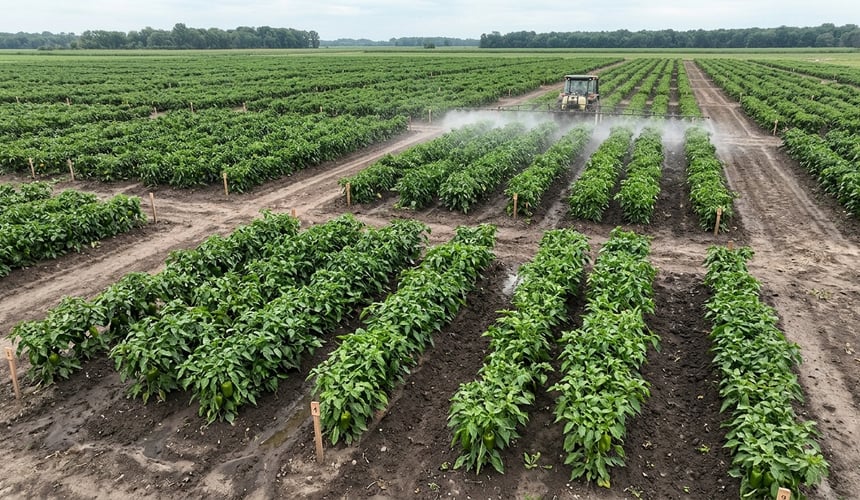
A grower sees a seaweed biostimulant produce a clear response in one field and very little difference in the next. Is the product inconsistent, or is the field the variable? Seaweed biostimulant field trials exist to answer that question, and they only do so well when the product effect can be separated from the weather, soil and water conditions around it.
Cropenta Insight
When comparing trial results, match each outcome to its measurement stage. A pigment reading taken on one date reflects the plant's condition at that time, while harvest weight integrates conditions across the whole season. Check whether the trial recorded soil moisture and rainfall during the period when the treatment was applied, because these records determine how a difference can be read against the conditions tested.
Why one season is rarely enough
Temperature, rainfall, light and humidity change from year to year, and each can influence how a crop grows and responds to a treatment. A single-season result therefore carries the imprint of that season. A two-year study on an Ascophyllum nodosum extract in pepper and eggplant, by N Staykov, is an example of a design that spans more than one growing period and reports yield-related outcomes across them.[1] Two seasons still represent only two weather patterns, so the result is best read as evidence for those crops and conditions rather than as a general rule.
Controlling for soil, water and site
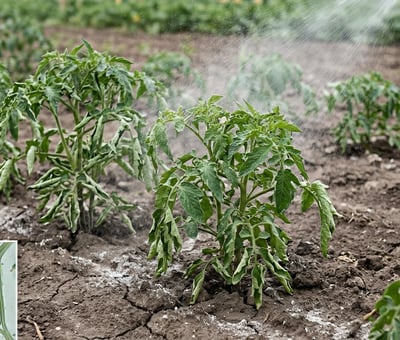
Environmental variation is not only about weather. Soil texture, fertility, drainage and water availability can differ within a single farm. Trials address this by placing treated and untreated plots side by side, repeating each treatment across blocks and recording site conditions. The aim is that a difference between plots can be attributed to the treatment with more confidence. Water is a particularly important factor. In a cotton study under water scarcity, leaf photosynthetic pigments were measured in the field, and the seaweed extract-based biostimulant was associated with higher leaf contents of chlorophyll a and total chlorophyll.[2] Testing under limited water shows the response under the condition the crop actually faces, but it does not show what would happen under full irrigation.
Physiological readings are not harvest results
Trials often record several things at once: leaf pigment content, plant condition, growth and harvest. These are not interchangeable. A change in leaf pigments shows a physiological response under the conditions measured, but it does not by itself show a larger harvest. Reliable trial reporting keeps these levels apart, and any yield conclusion has to rest on harvest measurements of their own.
Where the evidence stops
Even well-designed trials have limits. A result with one seaweed species does not transfer automatically to other seaweed species, and a result with one commercial extract does not establish how all extracts from the same species behave. Results in pepper and eggplant say nothing direct about cotton, and the reverse is also true. Non-significant or inconsistent outcomes across seasons or sites are informative too, because they show where a response depends on conditions. A single site or season cannot separate every environmental factor from the treatment, so some uncertainty always remains.
What a grower or adviser can take from a trial
When reading a trial, check how many seasons and sites were used, whether untreated controls ran in the same field, which soil and water conditions were recorded, and whether the reported outcome is a physiological reading or a harvest result. A trial that addresses these points gives a firmer basis for comparison. Results from one crop under one set of conditions are a starting point for on-farm observation, not a guarantee of response.
Technical Summary
Seaweed biostimulant field trials account for environmental variation through replicated, controlled comparisons, multi-season data and recorded site conditions. Physiological readings such as leaf pigment content show a response under the measured conditions but are not harvest results. Evidence is limited to the species, extract and conditions tested, and inconsistent or non-significant outcomes should be reported alongside positive ones.
This article was created with the help of AI and reviewed by the Cropenta editorial team. It is general information, not professional advice.
Technical Questions
Why can a physiological change in leaf pigments fail to show up as a harvest difference?
Leaf pigment content reflects the plant's physiological state at the time of measurement. Harvest weight depends on later processes, including flowering, fruit set and weather during fruit development. A physiological change can therefore occur without a measurable harvest difference, so each outcome needs its own measurement in a trial.
Why can a seaweed biostimulant trial give different results in two neighbouring fields?
Neighbouring fields can differ in soil texture, drainage, previous cropping, water availability and weather at critical growth stages. Any of these can change how a crop responds to the same treatment. This is why trials use untreated controls on each site and record site conditions before comparing results between fields.
Looking for something specific?
Our team is there to help you find the right raw materials and solutions for your formulations