Role of Full-Fat Extruded Soybeans in Young Poultry Diets
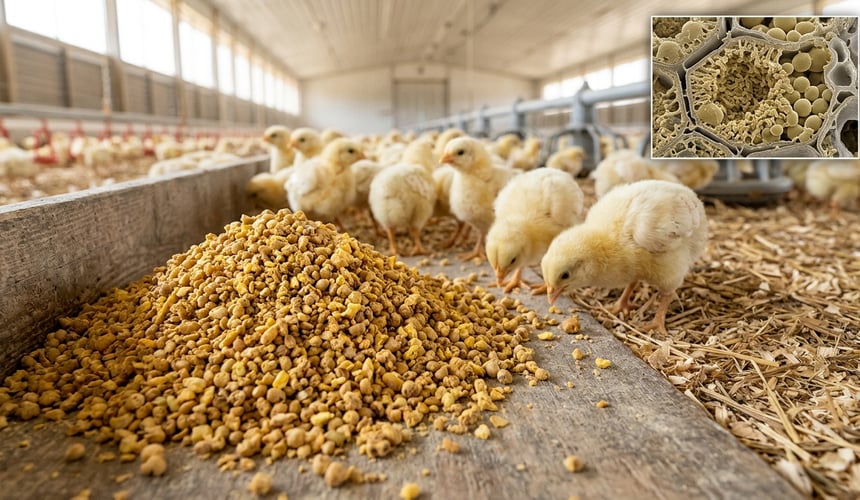
The practical question is straightforward: what does extrusion actually change in the bean, and how does that match the digestive physiology of a 21-day-old broiler that is still building its enzymatic capacity?
Cropenta Insight
Heat-treatment indicators and processing history, not a single urease reading, determine how much of a full-fat soybean batch a young bird can actually use. A broiler study comparing extruded and roasted beans measured standardized ileal amino acid digestibility with and without a multi-enzyme supplement, and the results varied by amino acid and by enzyme inclusion rather than favouring one process uniformly. Formulators should therefore ask for trypsin inhibitor activity, reactive lysine and digestibility data together before setting inclusion levels.
What processing does to the whole bean
Raw soybeans carry a combination of nutritional strengths and problems. The oil stays inside the cellular structure, giving the bean a high energy density, but heat-labile anti-nutritional factors — trypsin inhibitors and lectins — interfere with protein digestion if the bean is fed untreated. Under-processed beans leave these factors active; over-processed beans suffer Maillard reactions that bind lysine and lower digestibility. Extrusion is one way to navigate between those two failure modes.
Extrusion is a thermomechanical process. Temperature, moisture, pressure, residence time, screw configuration and shear forces act together as the material is forced through a die. The bean's structure changes: oil cells can rupture, the matrix opens up, and heat-labile anti-nutritional factors are reduced. It is important not to confuse extrusion with toasting, roasting or expelling. Toasting uses steam or dry heat, roasting applies dry heat in a drum or on a belt, and expelling presses oil out mechanically. Each produces a different product from the same raw bean.
Verifying heat treatment: no single number tells the story
Feed laboratories use several indicators to judge whether a full-fat soybean has been adequately processed, and they are not interchangeable. Trypsin inhibitor activity (TIA) is the most direct measure of residual heat-labile anti-nutritional factors. Urease activity is an indirect pH-rise test: a low value shows that heat was applied, but it does not prove optimal processing or rule out over-processing. KOH protein solubility falls with heat and flags over-processing when too low, while the Protein Dispersibility Index is another heat-treatment indicator with its own optimum range. Reactive lysine captures the fraction of lysine still available for digestion; total lysine can remain unchanged while reactive lysine drops after excessive heat. Amino acid digestibility measured in animals remains the only indicator that shows what the bird can actually use.
A formulation or quality team looking at a certificate of analysis should expect more than one of these values. A low urease reading on its own does not confirm that a batch has the right balance of protein quality and oil availability.
Broiler evidence: extrusion versus roasting
A study in 21-day-old broilers compared full-fat soybeans processed by extrusion or roasting and examined standardized ileal digestibility of amino acids, with and without a multi-enzyme supplement. The trial measured digestibility at the ileal level, which reflects what has been absorbed before the hindgut, and is the appropriate reference for poultry.[1] Processing method affected specific amino acid values and interacted with enzyme supplementation, rather than producing a uniform advantage for one method across all amino acids. The practical reading for formulators is that extruded full-fat soybeans can support amino acid supply in young broiler diets, but the choice between extruded and roasted beans depends on the actual processing parameters and how the supplier verifies them.
An earlier broiler study extruded soybeans at different temperatures and found that extrusion at 140 °C was associated with higher feed intake compared with beans extruded at lower temperatures, while other performance measures did not differ significantly.[2] That pattern — a change in intake without consistent changes in the other outcomes — is a reminder that extrusion temperature is one variable among several, and that a single trial rarely establishes a general rule.
Energy value and the oil matrix
Full-fat soybeans deliver both protein and oil in one ingredient, which is part of their appeal for young poultry. The oil is not simply soybean oil added back to a meal; it sits within a cellular and protein matrix, and extrusion can alter how accessible that oil is during digestion. This structural change does not by itself prove higher digestibility, and the published broiler data focus mainly on amino acid digestibility rather than on a measured energy value for extruded versus roasted beans.[1] Reviews of full-fat soybean meals in poultry feeding note that these ingredients can be used to support nutrition and product quality, provided the processing is appropriate for the species and age group.[3]
For young animals, the lipid fraction matters for more than energy density. Free oil added at high inclusion rates can overwhelm the digestive capacity of a very young bird, whereas oil held within a processed bean matrix may be released more gradually. This is a plausible mechanism consistent with the physical changes extrusion produces, but it should not be treated as a measured effect unless a specific trial has tested it.
Practical implications for young poultry formulations
Several operational observations follow from the evidence. First, when a supplier describes a full-fat soybean as extruded, formulators should ask which process indicators accompany the product: TIA, urease, KOH solubility, protein dispersibility, reactive lysine or ideally ileal amino acid digestibility values. A single urease result is not sufficient. Second, extrusion parameters vary between installations, and the same nominal process can produce different products; the ingredient's nutritional value is therefore installation-specific. Third, extruded full-fat soybeans are not a guaranteed replacement for soybean meal plus oil in every young poultry diet. The broiler data show comparable amino acid digestibility to roasted beans under the tested conditions. Inclusion decisions should be based on the specific product data and the target species and age.
For a feed mill, the practical question is whether the processing history of a given full-fat soybean batch is documented well enough to predict how it will behave in the mixer and in the animal. Where evidence is thin, a cautious inclusion strategy with monitoring of animal response is more defensible than assuming that extrusion alone solves the protein quality question.
Technical Summary
Extruded full-fat soybeans keep the bean's oil in the matrix while reducing heat-labile anti-nutritional factors through a thermomechanical process that differs from toasting, roasting and expelling. Broiler trials show standardized ileal amino acid digestibility comparable to roasted beans, with processing method and enzyme supplementation interacting on specific values. Urease alone does not prove adequate processing; TIA, KOH solubility, reactive lysine and animal digestibility together give a fuller picture.
This article was created with the help of AI and reviewed by the Cropenta editorial team. It is general information, not professional advice.
Technical Questions
Why can two extruded full-fat soybean batches differ in nutritional value despite the same process name?
Extrusion applies temperature, moisture, pressure, shear and residence time together, so two mills can produce different products from the same beans. The broiler trial showed that processing method interacts with enzyme supplementation on specific amino acid values, meaning the digestibility outcome depends on the actual parameters used, not on the process name alone. Formulators should request the specific processing indicators and, where available, ileal digestibility data for each product.
What does a low urease value actually tell a formulator about full-fat soybean quality?
Urease activity is an indirect pH-rise test. A low value shows that heat was applied, but it does not confirm optimal processing or exclude over-processing. Trypsin inhibitor activity directly measures residual heat-labile factors, KOH protein solubility and the Protein Dispersibility Index flag over- or under-processing, and reactive lysine captures Maillard damage. These indicators are complementary and should be interpreted together.
How should a nutritionist compare extruded and roasted full-fat soybeans when both show similar crude protein?
Amino acid digestibility measured in animals is the only indicator that shows what the bird can use. Composition data and heat-treatment indicators such as urease or KOH solubility describe the ingredient, not its nutritional outcome. For broilers, standardized ileal digestibility is the relevant reference because it captures absorption before the hindgut, whereas composition-based estimates cannot account for processing-induced changes in protein quality.
- 1.Amino acids and energy digestibility in extruded or roasted full fat soybean fed to broiler chickens
- 2.Response of broiler chicks to dietary full-fat soybeans extruded at different temperatures prior to or after grinding
- 3.Full-Fat Soybean Meals as an Alternative Poultry Feed Ingredient—Feed Processing Methods and Utilization—Review and Perspective
Looking for something specific?
Our team is there to help you find the right raw materials and solutions for your formulations