How Do Soil pH and Weather Influence Elemental Sulfur Oxidation?
A field can receive elemental sulfur and still show little sulfur supply to the crop in the first weeks after application. The reason is that elemental sulfur is not the form roots take up. Before a crop can use it, the element has to be converted into sulfate, and this conversion is a step that can influence how quickly sulfur becomes available. Growers and advisers who rely on elemental sulfur therefore need to know what factors may affect the speed of this conversion.
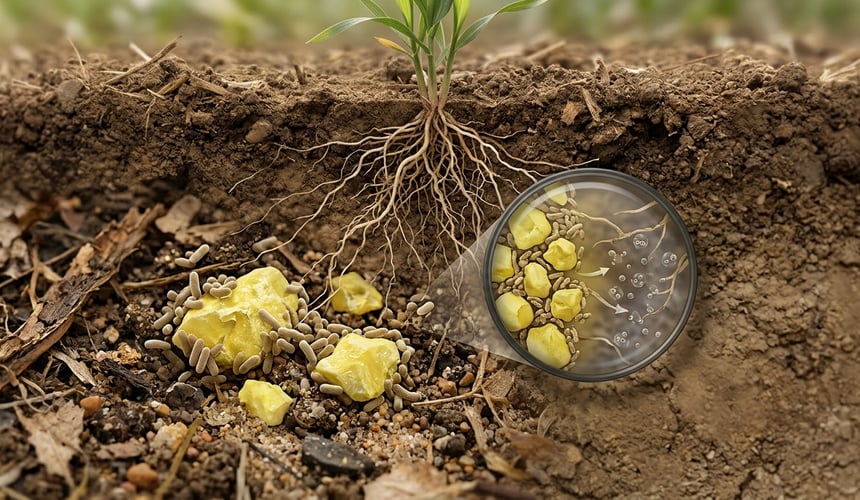
Elemental sulfur (S0) is widely used as a source of sulfur in agriculture, but it must be oxidized to a plant-accessible form.[1] Plants take up sulfur mainly as sulfate, so the oxidation step largely sets the timing of supply from the applied material.
Cropenta Insight
When planning an elemental sulfur application, compare the crop's period of highest sulfur demand with the expected time needed for sulfate to form. Because supply depends on a microbial conversion step, a material applied shortly before rapid growth may not match early demand. Keeping a simple record of application date, soil temperature and moisture, and visual sulfur symptoms across seasons gives a practical basis for adjusting timing in your own fields.
What happens in the soil
In most soils, elemental sulfur is oxidized by sulfur-oxidizing bacteria that use it as an energy source. The conversion runs through intermediate steps, including thiosulfate, before sulfate is formed. The sources available for this article do not quantify thiosulfate levels under different conditions, so its implications for field supply cannot be sized here.
A review of sulfur-oxidizing bacteria in agro-ecosystems reports that the oxidation of added elemental sulfur is typically around 40% to 51%.[2] This is a typical range reported in a review, not a guaranteed rate, and the conditions behind it are not specified in the source excerpt used here.
Soil pH, temperature and moisture
Soil pH is one of the factors discussed in relation to elemental sulfur oxidation. In a soil study, the pH decreased faster when elemental sulfur and sulfur-oxidizing bacteria were treated together, which points to a possible link between oxidation and soil acidification.[3] The same study does not establish a general pH threshold for the process.
Temperature and soil moisture are commonly considered as well, because they affect microbial activity. However, the excerpts available for this article do not provide separate, quantified results for pH, temperature and moisture, nor for how these factors interact. Any statement about one factor dominating the others would go beyond the evidence.
Agronomic relevance
The oxidation step may make the supply from elemental sulfur slower and less predictable, and the magnitude of this effect is not established by the sources used here. A soil that is cold, very dry or very wet may convert the material at a different pace. Results from one soil, crop or incubation do not transfer automatically to another field.
What the reader can take from this
The timing of sulfur supply from elemental sulfur is set by a microbial conversion that depends on the soil. Soil pH, temperature and moisture are the factors to watch, but the available evidence does not yet give reliable quantified rules for how they combine. Field observation over several seasons remains the most direct way to see how a particular soil handles this conversion.
Technical Summary
Elemental sulfur must be oxidized to sulfate, via thiosulfate, before plants can take it up. Sulfur-oxidizing bacteria drive this step. Reviewed data report typical oxidation of 40% to 51% for added elemental sulfur. Soil pH is linked to oxidation and acidification, while temperature and moisture are relevant but not quantified in the sources used.
This article was created with the help of AI and reviewed by the Cropenta editorial team. It is general information, not professional advice.
Looking for something specific?
Our team is there to help you find the right raw materials and solutions for your formulations