Fatty Acid Saturation and the Energy Value of Feed Fats
Two fat batches can carry the same analysed crude fat content and still behave differently in the animal. The difference is not explained by the fat content on the label, but largely by the fatty acid profile, and specifically by how saturated those fatty acids are. The practical question behind that observation is simple: what is the relationship between the degree of fatty acid saturation and the energy value that feed fats actually deliver to monogastric and ruminant animals?
Cropenta Insight
A fat's gross energy is nearly constant across sources; its usable energy is not. The saturation profile is associated with the melting point and with how readily bile salts and lipase can act, so the same megajoule figure can be realised differently between a young piglet and a finishing pig. That gap is where ingredient evaluation, not label reading, informs formulation value.
Why crude fat content says little about usable energy
Energy in feed fats is normally reported through a system, not as a single number. Gross energy is what combustion releases. Digestible energy subtracts faecal losses, metabolizable energy additionally subtracts urinary and gas losses, and net energy subtracts the heat increment of metabolism. Species and countries use different systems and tables, so fats can only be compared inside one system. Within that system, the fatty acid composition and saturation of the fat are associated with how much of the gross energy the animal can actually capture. A recent assessment of lipids used in non-ruminant nutrition makes the same point: fats and oils are the most concentrated energy source available to nutritionists and an expensive part of the diet, which is precisely why their true energy value deserves more than a crude fat figure [1].
What saturation does to digestion
Fatty acids differ in chain length and in the number of double bonds. Saturated fatty acids carry no double bonds and pack tightly, giving a higher melting point. Unsaturated fatty acids carry one or more double bonds, pack less tightly and melt at lower temperatures. That physical difference is involved in the digestion pathway. Bile salts and phospholipids emulsify fat into small droplets so pancreatic lipase can hydrolyse triglycerides, and the resulting fatty acids are carried to the intestinal wall in micelles. Saturated fatty acids are generally associated with a higher melting point and poorer emulsification, and experimental work has not consistently demonstrated that they are absorbed less efficiently in all situations; the effect depends on the animal's age and its bile salt and lipase output [1]. Unsaturated fatty acids are generally associated with more efficient absorption, although they are also more prone to oxidation, which is a separate quality issue that storage and antioxidant practice must manage.
Age changes the picture
Age-dependent fat digestion is one of the most consistent findings in monogastric nutrition. Young piglets and chicks produce limited bile salts and lipase, so fat digestibility rises with age. In young animals, the digestibility of highly saturated fats has been observed to be lower than that of unsaturated oils in several studies, and the difference narrows as the digestive system matures. This means a fat with a high saturated fatty acid content can look adequate in a finisher diet and disappoint in a nursery or starter diet, even when the analysed fat content is identical. In early-life diets, saturation is therefore treated as a first-order variable, not a footnote.
Free fatty acids, by-products and the saturation effect
Saturation is not the only driver. Acid oils and fatty acid distillates are by-products of edible oil refining that are rich in free fatty acids, and their composition varies with the refining stream they come from [2]. Free fatty acids are released fatty acids rather than intact triglycerides, and their digestion and absorption differ from those of triglycerides and phospholipids. Work on laying hens shows that both the degree of saturation and the free fatty acid content of a fat shape dietary preferences, which indicates that birds can distinguish these fractions and that both matter for intake and energy supply [3]. A high free fatty acid level combined with a high saturated fraction is a combination that deserves close scrutiny in any energy calculation.
What this means for formulation and purchasing
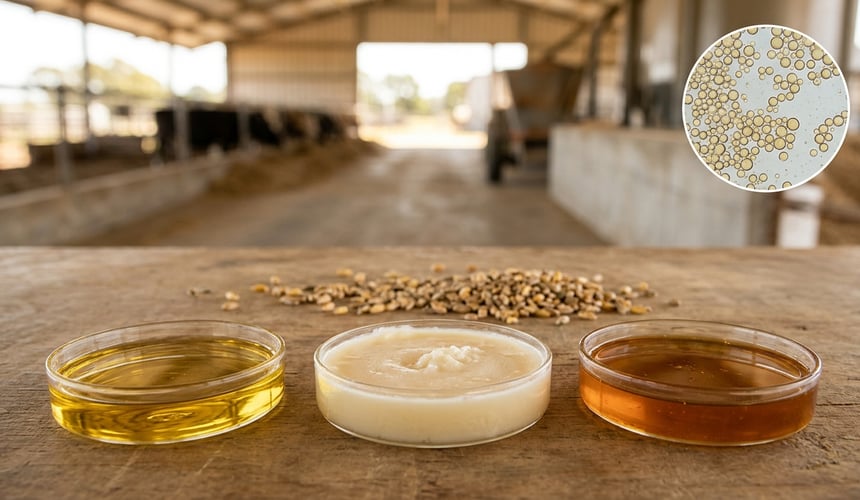
The practical consequence is that two fats with the same declared energy value may not be interchangeable. The fatty acid profile and the free fatty acid content should be considered alongside the standard fat analysis, and values should be compared within one energy system and one species. Where a fat is used as a carrier or as a source of phospholipids in a blend, the triglyceride, free fatty acid and phospholipid fractions should be kept apart in the evaluation rather than collapsed into a single number. A blend may be attractive for reasons of supply and handling, but neither those practical advantages nor a favourable appearance is by itself evidence of higher nutritional value; the fatty acid profile and the free fatty acid content remain the variables that need to be checked before a conclusion is drawn.
Limits of the evidence
The relationship between saturation and digestibility is well established for monogastrics, especially in young animals, but it is not a universal rule. Ruminants modify dietary fats through ruminal biohydrogenation, so the fatty acid profile reaching the small intestine differs from what was fed, and monogastric findings should not be transferred to ruminants without specific evidence. Fish results likewise do not carry over to poultry, pigs or cattle without additional work. Fat quality assessment is best treated as a profile question: saturation, free fatty acid content, chain length and oxidative status together, not any single number.
Technical Summary
The energy value of a feed fat depends on its fatty acid saturation profile, not only its crude fat content. Saturated fatty acids are associated with a higher melting point and poorer emulsification, and in young monogastric animals with limited bile salt and lipase output, highly saturated fats have been observed to be digested less well than unsaturated oils in several studies. Unsaturated fatty acids are generally associated with more efficient absorption but are more oxidation-prone. Free fatty acid content adds a second variable. Comparisons belong within one energy system and one species.
This article was created with the help of AI and reviewed by the Cropenta editorial team. It is general information, not professional advice.
Technical Questions
Why can two fats with the same analysed crude fat content differ in metabolizable energy?
Crude fat measures total lipid, not its composition. In young animals with limited bile salt and lipase output, highly saturated fats have been observed to be digested less well than unsaturated oils in several studies. Free fatty acid content and chain length add further variation. Energy value therefore depends on the fatty acid profile, not the fat content alone.
How should energy values be compared between different fat sources?
Compare within one energy system and one species. Gross energy, digestible energy, metabolizable energy and net energy are not interchangeable, and tables differ between countries. The position of a fat in the ranking can change when the comparison moves from a starter diet to a finisher diet, or from pigs to poultry.
Does a high free fatty acid content reduce the energy value of acid oils?
Free fatty acids are absorbed through a different route than intact triglycerides, and their energy contribution is not identical. When free fatty acids are combined with a highly saturated fraction, the effect on digestibility is more pronounced. Both fractions should be evaluated separately rather than assumed to behave like refined oil.
Can monogastric fat digestibility findings be applied to ruminants?
Not directly. Ruminal biohydrogenation modifies dietary unsaturated fatty acids before they reach the small intestine, so the profile absorbed differs from what was fed. Monogastric saturation findings should not be transferred to ruminants without specific evidence from rumen studies covering the same fat source and inclusion level.
- 1.Assessment of the quality, oxidative status and dietary energy value of lipids used in non-ruminant animal nutrition
- 2.Composition and Nutritional Value of Acid Oils and Fatty Acid Distillates Used in Animal Feeding
- 3.Degree of Saturation and Free Fatty Acid Content of Fats Determine Dietary Preferences in Laying Hens
Looking for something specific?
Our team is there to help you find the right raw materials and solutions for your formulations