How phospholipids regulate lipid transport and absorption in animal nutrition
Fat digestion in young animals is a race against limited capacity. A piglet or chick secretes little bile salt and pancreatic lipase early in life, so the physical state of dietary fat matters as much as its fatty acid profile. Phospholipids, supplied as lecithin or as part of a lecithin-containing fat blend, sit at the centre of that physical process. The reader question is specific: beyond acting as emulsifiers, how do phospholipids take part in fat digestion and absorption, and what does that mean for nutrient uptake and feed efficiency?
Cropenta Insight
The practical takeaway is that phospholipids should be judged by their position in the digestion sequence, not by their emulsifying label alone. Lecithin from soy, rapeseed or sunflower is a mixture of phospholipids, glycolipids and triglycerides, and its behaviour depends on raw material and processing. That composition determines how it interacts with bile salts, lipase and the enterocyte surface in a given diet and species.
Where phospholipids enter the digestion sequence
Triglycerides, free fatty acids and phospholipids are chemically distinct, and they are digested differently. Pancreatic lipase hydrolyses triglycerides into monoglycerides and free fatty acids. Phospholipids, by contrast, are resistant to pancreatic lipase and require phospholipase A2, which cleaves the fatty acid at the sn-2 position to release a lysophospholipid and a free fatty acid [1]. This distinction matters because lecithin added to a diet is not simply another triglyceride; it follows its own enzymatic route and contributes its own hydrolysis products.
Before any enzyme can work efficiently, fat must be dispersed. Bile salts and phospholipids emulsify fat into small droplets, expanding the surface available to lipase [2]. Emulsification improves the conditions for digestion, but an emulsifying property on its own proves no higher fat digestibility in a given diet. The measured outcome depends on the whole ration, the species and the age of the animal.
Micelle formation and the stability question
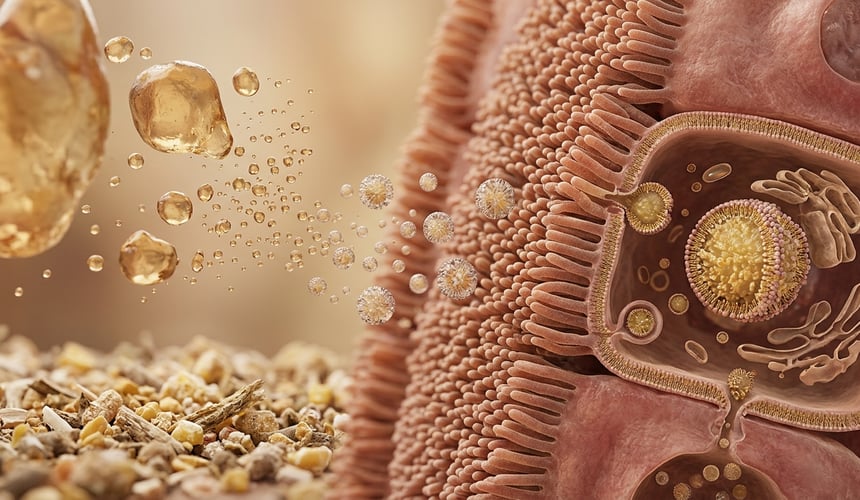
Hydrolysis products do not reach the intestinal wall as individual molecules. Bile salts, monoglycerides, fatty acids and phospholipids assemble into micelles, which act as transfer vehicles to the enterocyte membrane [2, 3]. This is where phospholipids contribute something more than droplet dispersion: they are part of the micelle structure itself, influencing how well the mixed micelle holds poorly soluble lipids in the aqueous phase of the gut.
In newborn animals, milk polar lipids provide choline, ethanolamine and polyunsaturated fatty acids needed for tissue growth and plasticity during suckling [4]. That is a physiological role of endogenous phospholipids in milk, not evidence that adding a commercial lecithin to a starter feed produces the same effect. The distinction between an endogenous process and an applied ingredient is essential when interpreting the literature.
From the enterocyte to chylomicron assembly
Once fatty acids and lysophospholipids cross into the enterocyte, they are re-esterified and packaged. Phospholipids are involved in intestinal lipid absorption by contributing to micelle formation, while cholesterol transport from the intestine is handled through related pathways [2]. Chylomicron formation depends on phospholipids as structural components of the lipoprotein surface, alongside apoproteins. Without sufficient phospholipid available for packaging, the export of absorbed lipid into lymph can become a limiting step.
This is the mechanistic reason phospholipids can matter beyond emulsification: they are consumed as building material during chylomicron assembly, not just as detergents in the lumen. The evidence for this mechanism is well established in intestinal physiology [2]. What is far less established is how much an added lecithin changes chylomicron output under practical farm conditions, and at what inclusion level any measurable effect on fat digestibility appears.
Formulation and feed manufacturing implications
In compound feed, lecithin appears in three different roles that should not be conflated: as a separate additive, as a component of a compound fat raw material, and as part of an oil blend positioned as an alternative to conventional fat sources. The nutritional value depends on which role is intended. A lecithin-oil blend carries energy from its triglyceride fraction as well as phospholipid functionality, whereas a low-dose lecithin additive is primarily functional.
Operationally, liquid fat blends behave differently in the mixer and on the pellet die. Free fatty acid content, moisture and storage temperature influence viscosity and pumpability. Fatty acid saturation influences digestion and oxidative stability in different ways across species and ages, so fatty acid profile, peroxide value, anisidine value and induction time are the practical checks on oxidative stability. A lecithin-containing blend with a high free fatty acid load may disperse well yet still require antioxidant protection and careful storage to avoid quality loss before it reaches the animal.
What the evidence supports and what it does not
Several limitations deserve explicit mention. Most mechanistic work on phospholipids and lipid absorption comes from physiology and cell studies, or from milk lipid research in newborns [2, 3, 4], not from commercial feeding trials in growing pigs or broilers. Species differences are substantial: bile salt and lipase capacity, gut transit and the fat sources used all differ between piglets, chicks, ruminants and fish. Research on fish lipid absorption does not transfer to poultry or pigs without additional evidence.
It is also worth noting that research on phospholipid digestion has proposed a role for phospholipase A2 [1], which implies that the enzyme must be present and active for that route to operate. In very young animals with immature pancreatic function, this pathway may be limited, which is one reason age-dependent fat digestion is such a relevant factor when evaluating any emulsifier strategy. Where a study reports a non-significant effect on fat digestibility despite an emulsifying benefit, that result should be reported as such rather than smoothed into a positive narrative.
Formulators should therefore treat phospholipid ingredients as one variable in a system that also includes bile salt status, lipase capacity, fatty acid saturation, the physical form of the fat and the age of the animal. Higher fat digestibility, even where measured, does not by itself prove better growth or feed conversion; those are separate outcomes requiring their own evidence.
Technical Summary
Phospholipids take part in lipid absorption at several points: emulsifying fat for lipase, forming part of mixed micelles that carry fatty acids to the enterocyte, and serving as structural components during chylomicron assembly. Phospholipase A2, not pancreatic lipase, is the proposed enzyme route for their hydrolysis. Emulsifying capacity alone does not establish higher fat digestibility, and most mechanistic evidence comes from physiology and milk-lipid research rather than farm trials.
This article was created with the help of AI and reviewed by the Cropenta editorial team. It is general information, not professional advice.
Technical Questions
Why does phospholipase A2 matter more than pancreatic lipase for lecithin digestion?
Pancreatic lipase acts on triglycerides, releasing monoglycerides and free fatty acids. Phospholipids resist that enzyme, and the literature proposes phospholipase A2 as the route that cleaves the fatty acid at the sn-2 position to yield a lysophospholipid and a free fatty acid. Formulators should therefore consider pancreatic enzyme maturity, especially in young animals.
Does a higher emulsifying capacity guarantee better fat digestibility in a broiler or piglet diet?
No. Emulsification improves the physical conditions for lipase activity, but measured fat digestibility depends on the whole ration, fatty acid saturation, bile salt status and animal age. Trials with emulsifiers sometimes show non-significant effects on fat digestibility. Emulsifying properties should be treated as one input, not as proof of a nutritional outcome.
How should a formulator treat lecithin added as an additive versus lecithin inside a fat blend?
The two roles differ nutritionally. A low-dose lecithin additive is primarily functional, while a lecithin-oil blend also supplies energy from its triglyceride fraction and its fatty acid profile. Compare blends against soybean oil within one energy system, and check free fatty acid content, moisture and oxidative stability rather than price alone.
Which processing and storage checks help when sourcing lecithin-containing fat blends?
Request peroxide value, anisidine value and induction time to judge oxidative stability, plus free fatty acid content and moisture. Unsaturated fatty acids oxidise readily, and high free fatty acid loads can affect handling and storage. Viscosity and pumpability also matter for liquid application in the mixer.
Looking for something specific?
Our team is there to help you find the right raw materials and solutions for your formulations