What the sources report on glycine betaine and amino acids in stressed plants
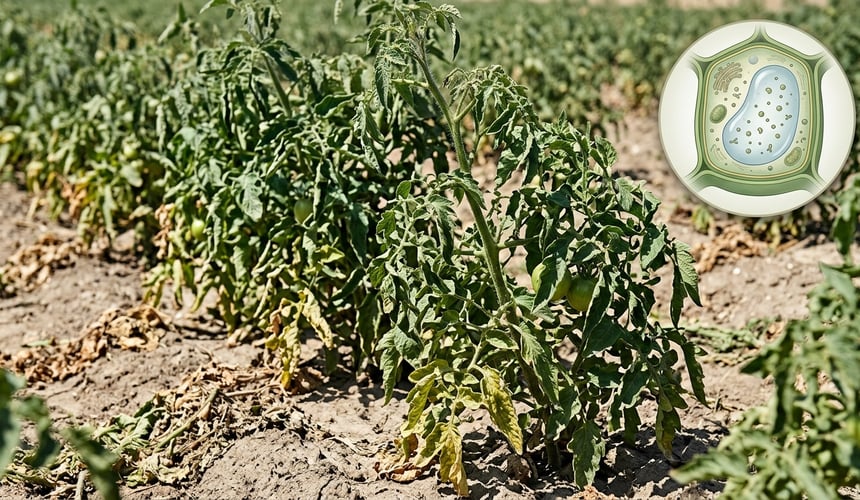
Plants under drought, heat or salinity often show the same early signs: slower leaf expansion, reduced growth and a greater need to keep cells hydrated. Two groups of compounds are often discussed in this context, glycine betaine and amino acids. Both occur naturally in plants, which raises a practical question for growers and advisers: do they act separately, or can their combination do something neither does alone?
Cropenta Insight
Much of the evidence on glycine betaine comes from studies of how plants make and accumulate it naturally, and such findings do not by themselves show what an applied treatment does in a field. For professionals reading the research, the distinction between an endogenous mechanism and an external application is the first thing to check. Where the physiological picture is still incomplete, it is safer to treat the combination as a research question rather than a settled practical advantage.
What each compound does inside the plant
Glycine betaine is a small nitrogen-containing molecule that some plant species accumulate when water availability falls or salinity rises. It is a compatible solute, meaning it can build up in the cell without interfering strongly with normal metabolism. Its accumulation contributes to osmotic adjustment, which lowers the cell's water potential so that water can still move into it. This capacity varies considerably between species, and not all plants synthesize and accumulate glycine betaine.[1]
Amino acids have a different but overlapping role. Free amino acids build up in many plants under stress, serve as nitrogen reserves, act as building blocks for proteins and feed into energy and nitrogen metabolism. Some of them also contribute to the osmotic balance of the cell. Osmotic adjustment alone does not mean that a plant uses less water or yields more, so a higher internal solute content should be read as a physiological response, not as a proven benefit.
Where the two pathways may meet
The review by Basit and colleagues suggests that glycine betaine may influence cell signalling, for example by altering the phosphorylation status of certain kinases, which are proteins that switch other proteins on or off.[1] Other reviews describe glycine betaine as interacting with plant hormones during abiotic stress, which places it within the wider signalling network that also governs amino acid use and metabolic priorities.[2]
Studies that examine exogenous glycine betaine together with amino acid composition and hormone metabolism have been reported mainly under controlled conditions. The sources available here do not establish whether such combined treatments produce a consistent effect in field crops, and results from one species cannot be generalised to others.
What the evidence does and does not show
The interaction between glycine betaine and amino acids is best described as plausible but not established for field crops. Most mechanistic detail comes from laboratory, controlled-environment and single-species work. The effect of an externally applied compound depends on concentration, timing, crop species and growing conditions, and the physiological endogenous role of glycine betaine does not prove that applied glycine betaine improves crop performance.
For advisers, the practical question is which measurable outcomes were actually recorded. Changes in hormone levels, amino acid profiles or photosynthetic parameters are physiological responses. They are not the same as yield, quality or recovery after stress, and the available sources do not provide field data that would confirm those outcomes for a combined treatment.
What growers can take from this
The combination of glycine betaine and amino acids is a sensible subject for trials, but the current literature does not support expectations of consistent results across crops. Observations on leaf condition, growth rate and recovery after a stress period are worth recording in one's own conditions before drawing conclusions about any treatment.
Technical Summary
Glycine betaine is a compatible solute that some plant species accumulate under osmotic stress. Amino acids serve as osmolytes, nitrogen reserves and metabolic intermediates. Published reviews describe possible links between glycine betaine, hormone signalling and kinase activity, while the reviewed sources examine the combination mainly under controlled conditions. Evidence for a field-relevant synergy is limited and species-dependent.
This article was created with the help of AI and reviewed by the Cropenta editorial team. It is general information, not professional advice.
Technical Questions
Does the presence of glycine betaine in a plant mean that applied glycine betaine will have the same effect?
Not necessarily. Some plant species accumulate glycine betaine naturally, and that accumulation is a physiological response. Applied glycine betaine is a different situation, and its effect depends on the crop, concentration, timing and growing conditions. Current evidence does not allow a direct transfer from natural accumulation to a treatment result.
Why are amino acid levels in a plant not a direct measure of stress recovery?
Free amino acids accumulate under many conditions, including normal development, nitrogen supply and stress. Their levels reflect metabolic status and nitrogen use, but a higher amino acid content does not on its own show that a plant has recovered or yields more. Recovery needs to be judged with observations of growth, photosynthesis and crop outcomes over time.
Looking for something specific?
Our team is there to help you find the right raw materials and solutions for your formulations