How Do Different Sulfur Forms Behave in Soil for Plant Availability?
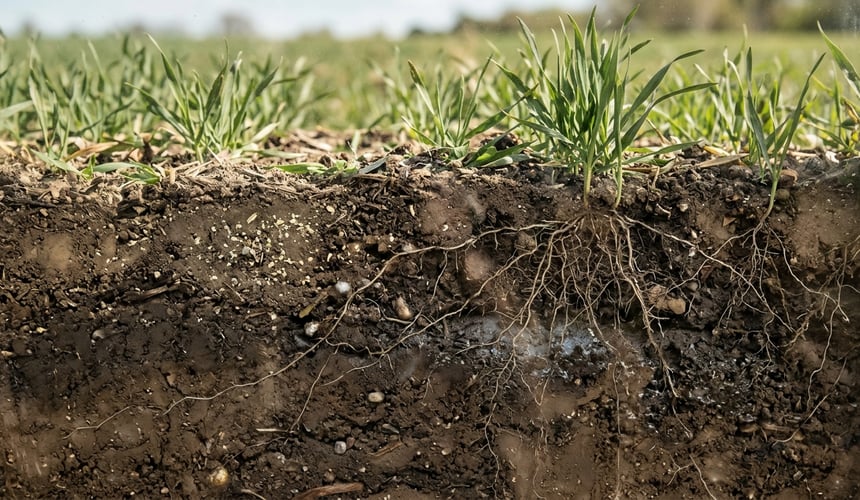
A grower spreads a sulfur fertilizer in spring and expects the crop to respond within weeks. Sometimes it does, and sometimes the response lags behind. The reason is that sulfur does not behave the same way in every form. Elemental sulfur, sulfate and thiosulfate start in different chemical states, and the soil changes them at different rates before roots can take them up.
Sulfur is needed for plant growth because it is a structural component of the amino acids cysteine and methionine, and therefore of proteins.[1] Plants take up sulfur mainly as sulfate from the soil solution, so availability depends on how quickly each applied form ends up in that pool.
Cropenta Insight
For professionals, the label form of a sulfur fertilizer describes its starting point, not its availability on the day of application. Elemental sulfur depends on soil microorganisms to oxidize it before plants can use it, so its effect is usually slower and depends on soil conditions. Sulfate is already in the plant-available form but can move with soil water. Pot-study evidence does not transfer directly to field timing, so field conditions should guide interpretation.
Elemental sulfur needs oxidation first
Elemental sulfur cannot be taken up by roots. Soil microorganisms must oxidize it to sulfate, a process that depends on temperature, moisture, aeration and the local microbial community. This conversion is typically slow compared with the uptake of ready-made sulfate.
The oxidation step also produces acid. Elemental sulfur is therefore associated with lower soil pH, but the size of the change depends on how much sulfur is oxidized and how strongly the soil buffers acid. In calcareous soils, carbonates neutralize much of this acid, which can limit the pH change. A lower pH is not automatically an improvement for crops.
Sulfate is available but mobile
Sulfate is the form roots take up directly. It dissolves in soil water and moves with that water, which makes it mobile. In wet, sandy or high-rainfall conditions, sulfate can be lost below the root zone, while soil chemistry determines how much is held in the soil. Because no oxidation step is needed, sulfate is the most immediately available of the three forms.
The Narayan review is mainly about the role of sulfur inside the plant and does not present a soil conversion study.[1]
Thiosulfate sits between the two
Thiosulfate is an intermediate in sulfur oxidation. It is neither elemental sulfur nor sulfate, and it should not be treated as chemically equivalent to either. Its conversion to sulfate is a further step that depends on soil conditions. The sources used here do not provide comparative conversion rates for thiosulfate, so its timing should not be assumed to match sulfate or elemental sulfur.
What the evidence shows and what it does not
A pot experiment with perennial ryegrass (Lolium perenne) compared different sulfur forms and examined soil organic matter fractions and soil microorganisms. The reported positive effects of sulfur fertilization were linked to higher nitrogen uptake. This was a controlled pot study on one grass species, so it does not show how each form performs in a field.[2]
The evidence explains the main routes: oxidation for elemental sulfur, soil water movement for sulfate, and an additional conversion step for thiosulfate. It does not provide a general rule for application timing. Soil pH, temperature, moisture, texture and crop demand all influence the outcome. Elemental sulfur also should not be confused with gypsum, which is used in sodic soils for different reasons.
Technical Summary
Elemental sulfur must be oxidized to sulfate before roots can take it up. This step is generally slower and produces acidity, and the pH effect depends on soil buffering. Sulfate is directly plant-available but mobile in soil water. Thiosulfate is an intermediate whose conversion timing is poorly documented in the sources used. Pot-study evidence does not replace field data on timing.
This article was created with the help of AI and reviewed by the Cropenta editorial team. It is general information, not professional advice.
Technical Questions
Why can a crop show sulfur deficiency signs after a sulfur fertilizer was applied?
Symptoms can appear when the applied form is not yet in the plant-available sulfate form. Elemental sulfur oxidation is slow in cold, wet or poorly aerated soils, so supply may lag behind crop demand. Visible symptoms alone cannot separate sulfur shortage from nitrogen or other nutrient problems, so soil and plant analysis are needed for interpretation.
Does a lower soil pH after elemental sulfur application always benefit the crop?
No. Acidification from elemental sulfur oxidation depends on how much sulfur is oxidized and on soil buffering capacity, and calcareous soils can resist pH change. A lower pH is not automatically an improvement, because it can change the availability of other nutrients. The effect should be judged against the actual soil pH and the crop requirements.
Looking for something specific?
Our team is there to help you find the right raw materials and solutions for your formulations