What Field Trials Show About Silicon in Crop Production
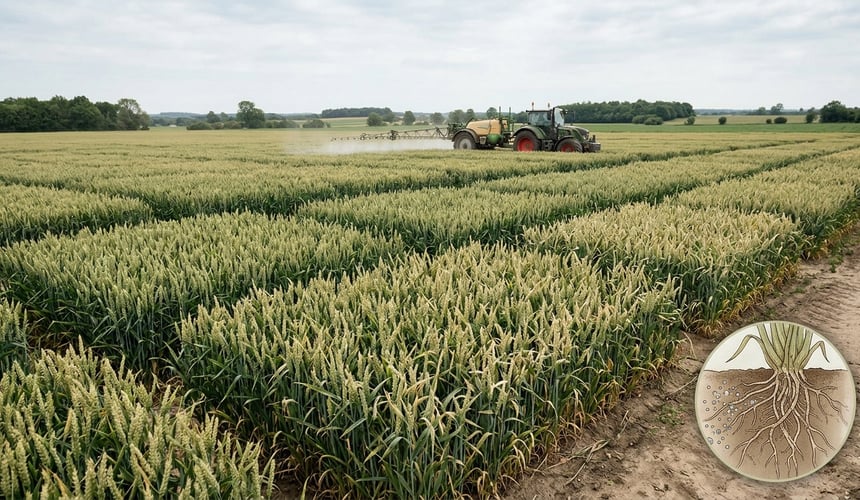
A grower who applies silicon in a dry season wants to know whether the crop responded in the field, not only in a pot. Lab and greenhouse work can show how silicon moves through a plant, but it cannot show how a whole field behaves across soils, rainfall and rotations. Field trials are the attempt to close that gap.
Cropenta Insight
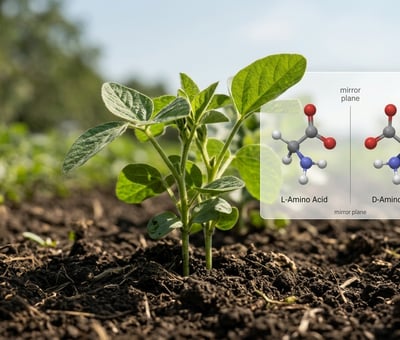
For silicon, the chemistry of the applied form matters as much as the dose. According to the company, plants take up silicon from the root as orthosilicic acid, H4SiO4, and this monomeric form stays dissolved at neutral pH only up to about 2 mmol/L, above which it condenses into polymers that are not absorbed in the same form. A field result should be read with the applied form and its absorbable fraction in mind, not only the total silicon content on a label.
How field trials are set up
A field trial usually compares treated and untreated plots, or different silicon programs, under the same conditions and with replicated plots. Researchers record yield, quality, plant development and visible responses during dry or saline periods. Soil silicon supply, rainfall and cultivar differ from site to site, so a single season tells little on its own. This is why results are often pooled across many trials and reviews.
Crops also differ in how much silicon they take up and accumulate. Rice is a strong silicon accumulator, and findings from rice do not automatically apply to species that accumulate less.[1]
What the aggregated results show
A review of European literature on silicon fertilization reports positive effects on yield and quality in many cases, and a reduced susceptibility to drought stress in a number of them.[2] A later review focusing on drought and saline conditions reports significant gains in productivity in roughly 75 to 88 percent of the cases it covered.[3] These figures summarize many experiments across different crops and conditions. They describe a pattern in the literature, not a guaranteed result for one field.
Where the evidence is limited
Not every trial shows a clear response. Results depend on soil silicon status, water supply, crop species and the form applied, and non-significant results are part of the picture. Because silicon accumulation varies strongly between species, a response measured in one crop cannot be assumed for another. A difference between treated and untreated plots also does not prove cause; weather or management that coincided with the treatment may account for part of it. Trial design, replication and duration determine how much weight a result can carry.
For a grower or adviser, the useful question is less whether silicon works in general and more whether trials on comparable soils, crops and water conditions recorded a response, and whether the applied form is known to reach the plant in absorbable form.
Technical Summary
Field trials test silicon under real soil, weather and management conditions, where results are reported as aggregated patterns across experiments. Reviews of field and literature data describe positive productivity effects in many cases under drought and saline conditions, with significant variation between crops and sites. According to the company, plant uptake relates mainly to monomeric orthosilicic acid, which polymerizes above about 2 mmol/L at neutral pH. Results should be read by crop, condition and applied form.
This article was created with the help of AI and reviewed by the Cropenta editorial team. It is general information, not professional advice.
Technical Questions
Why can a silicon field result differ between two fields with similar crops?
Soil silicon supply, rainfall, irrigation and cultivar all influence how a plant responds. Two fields can therefore give different results even when the same silicon program is applied, which is why trial results are best compared by soil type, crop and water conditions.
Does a high silicon content on a fertilizer label confirm that the plant will take it up?
Not necessarily. Silicon uptake is often discussed in terms of monomeric orthosilicic acid. According to the company, above about 2 mmol/L at neutral pH silicic acid polymerizes into silica that is not absorbed in the same form, so the chemical form and concentration in the spray or irrigation solution matter alongside the total silicon content.
- 1.The Multiple Role of Silicon Nutrition in Alleviating Environmental Stresses in Sustainable Crop Production - PMC
- 2.Effect of Silicon Fertilization on Crop Yield Quantity and Quality—A Literature Review in Europe - PMC
- 3.The Use of Si-Based Fertilization to Improve Agricultural Performance | Journal of Soil Science and Plant Nutrition | Springer Nature Link
Looking for something specific?
Our team is there to help you find the right raw materials and solutions for your formulations