Do Hydrolysis Conditions Change the L- and D-Amino Acid Mix in Biostimulants?
Most amino acids in plant and animal proteins are L-forms, yet a protein hydrolysate sold as a biostimulant can contain D-amino acids, the mirror-image forms of the same molecules. How much you get depends on how the protein was broken down. Here is what the literature says about that link, and where the evidence runs out. When comparing raw materials, ask suppliers about the hydrolysis route, but rely on stereochemistry analysis for proof.
Cropenta Insight
The practical gap lies between a process description and a measured composition. Hydrolysis route, temperature, pH and enzyme choice are plausible drivers of the L- and D-amino acid balance, but the reviewed sources do not quantify them, so product comparisons cannot be made from the literature alone. Professionals comparing amino acid raw materials can treat the production route as a question to clarify with the supplier, and an analytical stereochemistry result as the evidence that actually answers it.
What L and D forms mean for plants
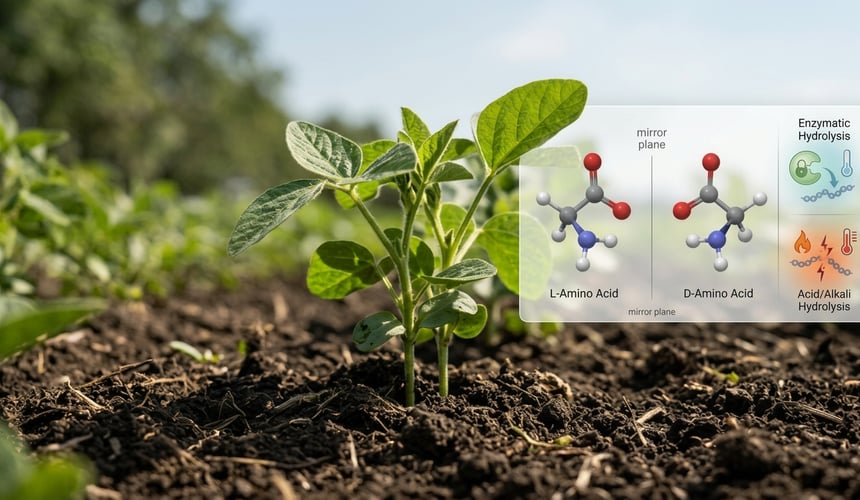
Amino acids can exist as two mirror-image forms, called L and D. They have the same chemical formula but a different spatial arrangement. Plant proteins are built from L-amino acids. D-amino acids have been described in plant systems, and the review on D-amino acids in plants describes their sources and metabolism. It notes that Arabidopsis thaliana roots exude D-amino acids into the rhizosphere, the soil zone around the roots.[1]
Where hydrolysis enters the picture
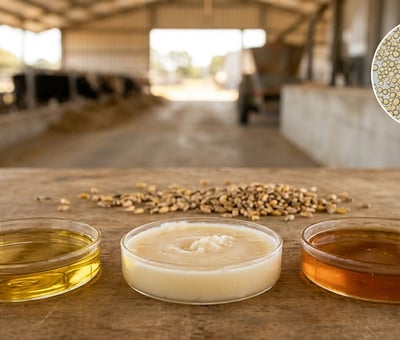
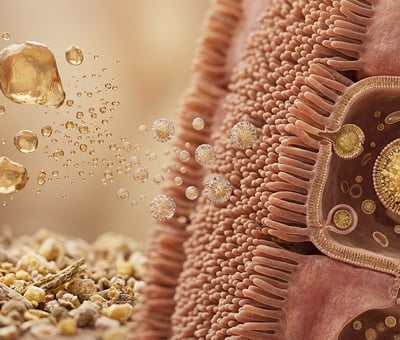
Protein hydrolysates are mixtures of polypeptides and free amino acids produced by enzymatic or chemical breakdown of agro-industrial protein by-products.[2] Hydrolysis aims to release amino acids from the protein chain and recover them in the product.[3] The method matters for what ends up in the mixture.
Enzymatic hydrolysis uses proteases, enzymes that cut peptide bonds in a stereospecific way, so the L-forms are typically the ones released from natural protein. Chemical hydrolysis uses strong acid or base at high temperature, conditions under which some amino acids can be broken down or converted to their mirror forms. These are general chemical and enzymatic principles, not results measured in the sources reviewed here.
Which parameters the evidence covers, and which it does not
Temperature, pH, enzyme type and reaction time are the parameters that would be expected to influence the ratio. The sources reviewed here do not report measured L to D ratios across these settings, nor direct comparisons between enzymatic and chemical routes. The available research therefore cannot show how far a given route shifts the ratio, or at which temperature or duration such a shift becomes relevant.
Why the ratio matters for agronomy, and what remains open
A D-amino acid in a product is not the same as a D-amino acid that a plant produces itself. Whether applied D-forms are taken up, metabolised or affect plant processes has not been established in the sources reviewed here. The functions of D-amino acids in plants are described as an area with open questions.[1] No study in this set links a hydrolysis parameter to a crop response, so any link to efficacy remains a hypothesis.
Measured stereochemical data is the missing piece. Without it, an ingredient list naming amino acids says little about the L and D balance, and the production route is only a partial indicator. A process description can guide questions to a supplier, but it does not replace analysis.
What the reader can conclude
The evidence supports one clear distinction. Hydrolysis route can, in principle, shape the chemical makeup of a protein hydrolysate. The size and direction of L and D shifts under specific temperature, pH, enzyme or time settings are not quantified in the reviewed literature, and the plant response to applied D-forms is not demonstrated.
Technical Summary
Hydrolysis route is expected to influence the L- to D-amino acid balance of protein hydrolysates, mainly through enzyme specificity and harsh chemical conditions. The reviewed sources do not quantify temperature, pH, enzyme or duration effects. The functions of D-amino acids in plants remain partly open, and the presence of a D-form in a product does not establish plant uptake or efficacy.
This article was created with the help of AI and reviewed by the Cropenta editorial team. It is general information, not professional advice.
Technical Questions
Does a D-amino acid listed in a biostimulant mean the plant will take it up and use it?
Not necessarily. The sources reviewed here do not show whether applied D-amino acids are taken up, metabolised or active in plants. D-amino acids have been described in some plant systems, but the functions of those forms are still under investigation, so an applied D-form cannot be assumed to behave the same way.
Why is the hydrolysis route relevant if the L and D ratio has not been quantified?
The route indicates which conditions the protein was exposed to. Enzymatic hydrolysis is generally expected to retain L-forms because of enzyme specificity, while harsh chemical conditions can alter some amino acids. These are expectations from chemical and enzymatic principles. Measured stereochemical analysis is needed to confirm the actual ratio in a given product.
Looking for something specific?
Our team is there to help you find the right raw materials and solutions for your formulations