How Does pH Influence Raw Material Compatibility in Liquid Fertilizer Formulations?
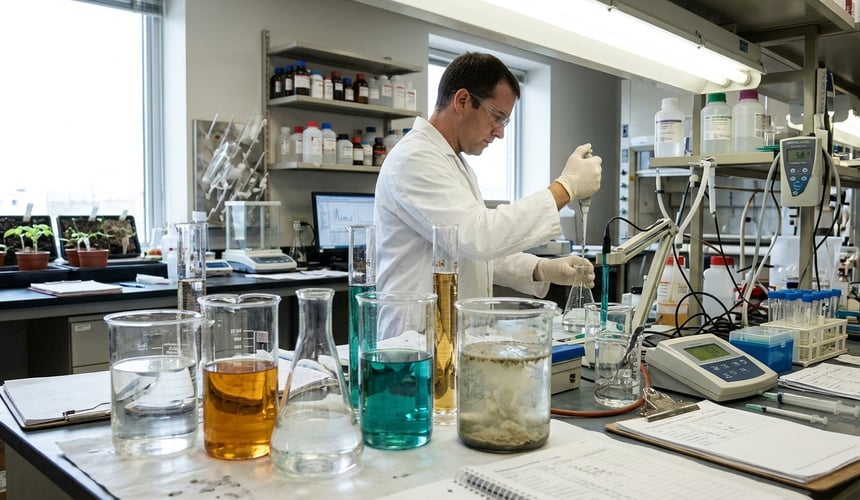
In liquid fertilizer and biostimulant formulations, the chemical environment's pH plays a critical role in determining the compatibility of raw materials. Variations in pH can significantly alter the chemical state, solubility, and reactivity of different ingredients, leading to issues such as precipitation, degradation, or reduced effectiveness. Understanding these pH-dependent interactions is essential for creating stable and effective liquid products for agriculture.
Cropenta Insight
The stability of raw materials in liquid formulations is profoundly influenced by pH, impacting factors from solubility to molecular charge. For formulators and agricultural professionals, recognizing how pH governs these interactions helps prevent issues like precipitation or degradation.
The Fundamental Role of pH in Formulation Stability
The pH of a liquid formulation directly influences the chemical form of its constituent raw materials. Many nutrient ions, organic acids, and other compounds exist in different protonated or deprotonated states depending on the surrounding pH. These different chemical forms can have vastly different solubilities and reactivity profiles [1, 2]. For instance, some metal ions may precipitate as hydroxides at higher pH levels, while others may form insoluble salts with phosphate or sulfate ions at specific pH ranges.
This principle extends beyond mineral nutrients. The physicochemical properties of applied materials, including their solubility and interaction potential, are significantly influenced by pH [2]. As such, a raw material that is perfectly soluble and stable at one pH might become insoluble or reactive when the pH shifts, leading to sedimentation or phase separation in the final product.
Chemical Mechanisms of Incompatibility
Several chemical mechanisms drive pH-dependent incompatibility in liquid formulations:
- Precipitation: As pH changes, the solubility limits of certain salts can be exceeded. For example, calcium and magnesium can react with phosphates or sulfates to form insoluble precipitates, particularly in alkaline conditions. Such interactions may be a concern when formulating complex nutrient blends.
- Complexation and Chelation: The effectiveness of chelating agents, which are often used to keep micronutrients soluble, is highly pH-dependent. At certain pH levels, the chelate bond may weaken, releasing the metal ion to react with other components or precipitate.
- Hydrolysis: Certain organic compounds, such as specific amino acids or biostimulant molecules, may be subject to hydrolysis at extreme pH levels (very acidic or very alkaline), which can lead to their degradation.
- Redox Reactions: pH can also influence the oxidation-reduction potential of a solution, potentially triggering unwanted redox reactions between raw materials that are otherwise stable at a different pH.
Practical Considerations for Managing pH in Formulations
Managing the pH of liquid fertilizer and biostimulant formulations is crucial for maintaining product stability and efficacy. Formulators often need to adjust pH to keep all raw materials in their optimal soluble and stable forms.
Conclusion
The pH of a liquid fertilizer or biostimulant formulation is a primary determinant of raw material compatibility and overall product stability. By influencing the chemical forms and solubility of ingredients, pH can lead to complex interactions, including precipitation, degradation, or reduced effectiveness. Understanding these mechanisms enables formulators to anticipate and address potential incompatibility issues, ensuring that agricultural liquid products remain stable and functional from production to application.
Technical Summary
pH critically influences raw material compatibility in liquid fertilizer and biostimulant formulations by altering the chemical forms, solubility, and reactivity of ingredients. Variations in pH can induce precipitation, disrupt chelation, or cause hydrolysis, leading to formulation instability. Effective pH management, careful testing, and strategic mixing procedures are essential to maintain the stability and efficacy of these complex agricultural solutions.
Disclaimer
This article has been prepared with AI assistance using publicly available sources and is intended solely for general technical and educational purposes. It does not constitute professional advice or recommendations for specific applications. Cropenta makes no warranties regarding the accuracy, completeness or applicability of the information. No rights may be derived from its contents, and Cropenta accepts no liability for its use to the extent permitted by law.
Technical Questions
How does pH affect the solubility of mineral nutrients in solution?
pH significantly alters the charge and chemical form of mineral ions. For example, some metal cations form insoluble hydroxides at higher pH, while others may be more soluble. Conversely, some anions, such as phosphates, may precipitate with calcium at specific alkaline pH levels. This can influence their availability and the overall stability of the liquid formulation.
What role do chelating agents play in pH-dependent compatibility?
Chelating agents help keep micronutrients soluble by forming stable complexes, preventing their precipitation across a range of pH values. However, the stability of these chelate complexes is also pH-dependent. At extreme pH levels, the chelating agent's efficacy may decrease, leading to the release of the metal ion and potential incompatibility issues.
Are there specific pH ranges to avoid for common liquid fertilizer raw materials?
There are no universal specific pH ranges to avoid for all common liquid fertilizer raw materials. The optimal pH range for stability and compatibility varies significantly based on the chemical nature of each raw material.
Related articles
Related Products




Looking for something specific?
Our team is there to help you find the right raw materials and solutions for your formulations

