Why Different Crops Accumulate Silicon in Distinct Ways
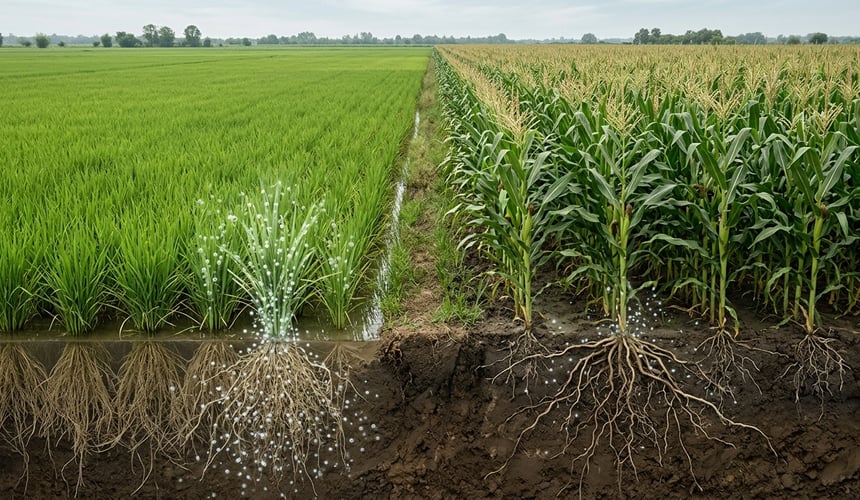
When observing various crop species, it becomes evident that some accumulate significantly more silicon than others. This raises a fundamental question for agronomists and crop nutrition specialists: why do certain crops naturally absorb and store much more silicon, and what determines these substantial differences? The answer lies in the physiological and genetic mechanisms governing silicon uptake and transport within the plant.
Cropenta Insight
Understanding the varying capacities of crops to accumulate silicon is crucial for developing effective nutrient strategies. Results from studies on high-silicon accumulators like rice may not be universally applicable to all crops due to distinct uptake mechanisms. This physiological diversity underscores the need for crop-specific approaches in silicon nutrition programs, guiding the selection of raw materials and formulations for specialized fertilizers and biostimulants that consider the plant's natural silicon acquisition pathways.
Mechanisms of Silicon Accumulation in Crops
Once inside the plant, silicon moves predominantly with the transpiration stream. However, the extent of silicon accumulation varies widely among plant species, categorizing them into 'accumulators' and 'non-accumulators' [1].
These differences are often attributed to specialized silicon transporters. Subsequently, Lsi2 moves silicon from cortical cells into the xylem, facilitating long-distance transport to aerial parts of the plant. This coordinated action of Lsi1 and Lsi2 may result in active and substantial silicon uptake, often exceeding passive water flow [1].
Crop-Specific Differences in Silicon Uptake and Transport
Conversely, in non-accumulating or low-accumulating crops such as many dicotyledonous plants, these specialized transporters are either absent or present in much lower concentrations, or they may possess different transport efficiencies. This means silicon uptake in these species is often more passive, largely dependent on the transpiration rate, and consequently, the silicon concentration within their tissues remains significantly lower than in accumulators [1]. For instance, studies indicate that while silicon can influence nutrient uptake in non-stressed maize (a moderate accumulator) and other crops like carrot and lettuce, the mechanisms and accumulation levels may differ considerably from those observed in high accumulators [2].
This inherent physiological variation explains why findings on the silicon dynamics of high-accumulating species like rice do not automatically apply to all other crops [1]. The genetic background of each crop dictates its capacity for silicon acquisition and internal distribution, which can influence its structural characteristics and water-use efficiency under various environmental conditions [3].
Implications for Agronomic Practice
Understanding these crop-specific differences in silicon accumulation is crucial for developing targeted crop nutrition programs. For crops with efficient silicon uptake systems, silicon application may lead to higher tissue concentrations and associated physiological effects. However, for crops that are less efficient accumulators, the approach to silicon application may require different considerations, as their ability to benefit from added silicon may be limited by their inherent physiological capacities [1]. It suggests that while liquid silicon fertilizer amendments may influence nutrient value in some crops [4], the extent of silicon accumulation is always moderated by the crop's specific uptake machinery.
The distinct ways crops accumulate silicon are a direct consequence of their specific genetic makeup and the presence and activity of specialized silicon transporters. This physiological diversity means that silicon uptake is not a uniform process across all species, highlighting the importance of acknowledging these inherent differences when evaluating research or designing crop nutrition strategies.
Technical Summary
Crop species vary significantly in silicon accumulation due to distinct physiological and genetic factors. High-accumulators, like rice, possess specialized Lsi1 and Lsi2 transporters for active uptake of orthosilicic acid, whereas low-accumulators often rely on passive uptake. This genetic variation dictates silicon content and influences how crops may respond to silicon applications, emphasizing the need for crop-specific approaches in nutrient management.
Disclaimer
This article has been prepared with AI assistance using publicly available sources and is intended solely for general technical and educational purposes. It does not constitute professional advice or recommendations for specific applications. Cropenta makes no warranties regarding the accuracy, completeness or applicability of the information. No rights may be derived from its contents, and Cropenta accepts no liability for its use to the extent permitted by law.
Technical Questions
Can research findings on silicon use in rice be directly applied to corn or other crops?
Not directly. Many other crops, including corn (a moderate accumulator), possess different or less efficient uptake mechanisms. Therefore, research results demonstrating silicon's physiological effects in rice may not be replicated or apply similarly to crops with distinct silicon acquisition capacities.
Related articles
Related Products


Looking for something specific?
Our team is there to help you find the right raw materials and solutions for your formulations

