How Growers Can Evaluate Microbial Biostimulant Efficacy Beyond Lab Data
The agricultural market offers a wide range of microbial biostimulant products, each promising various benefits for crop performance. However, growers and agronomists often seek clarity on how to differentiate products that genuinely perform in the field from those whose effects are primarily demonstrated under laboratory conditions or through marketing claims. Understanding the distinction between a microorganism's survival, its activity in a controlled environment, and its demonstrated effect in complex field ecosystems is crucial for informed decision-making.
Evaluating the actual field efficacy of microbial biostimulants requires a robust approach that extends beyond simple lab tests. It involves understanding the specific mechanisms of action and, more importantly, observing consistent and measurable crop responses under diverse environmental and agronomic conditions.
Cropenta Insight
Assessing microbial biostimulant efficacy requires distinguishing laboratory viability from real-world field performance.
Evaluating Microbial Biostimulant Efficacy Beyond Lab Settings
Microbial biostimulants comprise beneficial microorganisms that may play a role in plant nutrient acquisition and physiological processes [1, 2]. However, the path from initial laboratory observation to reliable field application involves distinct evaluation steps. These steps separate merely viable organisms from those demonstrating consistent crop benefit. First, it is essential to establish the organism's survival, ensuring it remains alive and in sufficient quantities after formulation and application. Second, its intended activity, such as nutrient mobilization or root colonization, must be confirmed, often initially in vitro. Critically, these two steps alone do not guarantee an observable crop benefit in a variable field environment [1].
The Gap Between Laboratory Activity and Field Performance
Laboratory and greenhouse studies are valuable for understanding the potential mechanisms of microbial biostimulants, such as phosphate solubilization or nitrogen fixation under controlled conditions [2]. These environments allow for precise control over factors like soil type, moisture, temperature, and nutrient availability. While such studies may show promising activity or physiological responses, these results do not automatically translate to commercial field efficacy. The soil microbiome is complex, with numerous competing microorganisms and fluctuating environmental factors that can significantly alter the performance of an introduced microbial product [1].
For example, a study evaluating microbial biostimulants alongside varied nitrogen rates in corn observed minimal synergistic benefits . This illustrates that even when specific microbial activities are known, their interactions within a complex cropping system may not always result in additive or measurable agronomic advantages. This indicates the importance of testing under conditions that reflect actual agricultural practices [3].
Types of Evidence for Field Efficacy
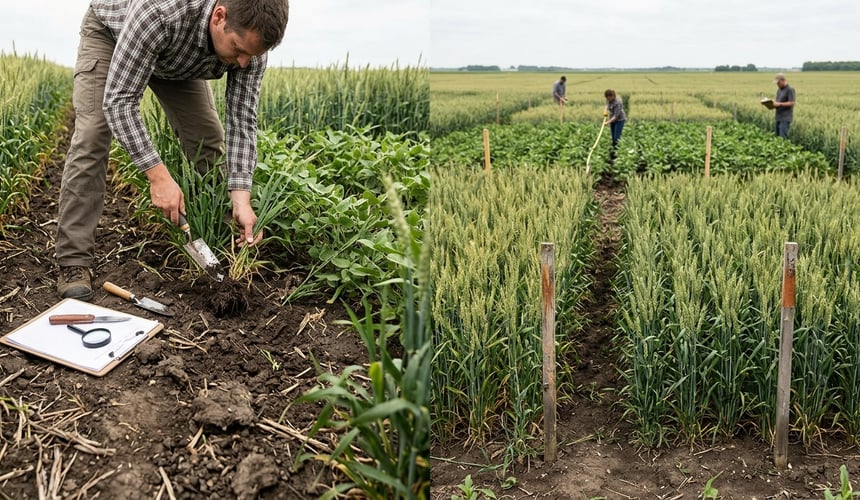
To confirm the genuine field efficacy of microbial biostimulants, growers and agronomists should look for evidence from well-designed and replicated field trials. These trials involve applying the biostimulant under typical growing conditions, comparing treated plots against untreated controls, and evaluating relevant crop parameters, such as nutrient use efficiency or physiological markers of plant development [1, 4]. Key characteristics of robust field efficacy data include:
- Replicated Trials: Multiple repetitions across different plots minimize the impact of localized soil variability or other environmental factors.
- Multi-season Data: Performance should be consistent across several growing seasons to account for seasonal weather fluctuations.
- Diverse Environments: Data from various soil types, climates, and cultivation practices helps establish broader applicability.
- Agronomic Endpoints: Focus on direct crop benefits, such as improvements in root development, nutrient uptake, or physiological responses under relevant conditions, rather than solely on laboratory measurements.
Understanding these aspects helps bridge the gap between initial scientific findings and practical application, providing a clearer picture of a microbial biostimulant's potential under real-world conditions.
Technical Summary
Assessing microbial biostimulant efficacy requires moving beyond laboratory survival and activity to demonstrated field performance. Robust evaluation necessitates replicated field trials across multiple seasons and diverse environments. Key evidence includes consistent crop responses related to nutrient use efficiency, root development, or physiological markers. This rigorous approach helps validate the actual impact of microbial products within complex soil and plant systems.
Disclaimer
This article has been prepared with AI assistance using publicly available sources and is intended solely for general technical and educational purposes. It does not constitute professional advice or recommendations for specific applications. Cropenta makes no warranties regarding the accuracy, completeness or applicability of the information. No rights may be derived from its contents, and Cropenta accepts no liability for its use to the extent permitted by law.
Technical Questions
What is the difference between microbial viability and activity in biostimulant evaluation?
Microbial viability confirms if the microorganisms in a product are alive and capable of reproduction. Activity, on the other hand, refers to their specific biochemical functions, such as nutrient solubilization or hormone production, often measured in vitro. Both are critical initial assessments, but neither guarantees successful establishment or observable crop benefits in diverse field conditions.
Why do laboratory results for microbial biostimulants often not translate to field performance?
Laboratory environments are highly controlled, minimizing variables. In contrast, field conditions present complex challenges: fluctuating temperatures, moisture levels, diverse soil microbiomes, and competitive interactions. These factors can significantly influence the survival, establishment, and metabolic activity of introduced microorganisms, leading to inconsistent or absent effects compared to controlled settings.
What should growers prioritize when reviewing microbial biostimulant trial data?
Growers should prioritize data from independent, replicated field trials conducted over multiple seasons and in diverse agro-ecological zones relevant to their own conditions. Look for trials that measure direct agronomic endpoints like nutrient use efficiency or physiological crop responses, rather than solely relying on in vitro activity or greenhouse observations. Consistency across trials is a strong indicator of potential field efficacy.
Related articles



Related Products


Looking for something specific?
Our team is there to help you find the right raw materials and solutions for your formulations

