How Different Surfactants Influence Foliar Uptake of Nutrients
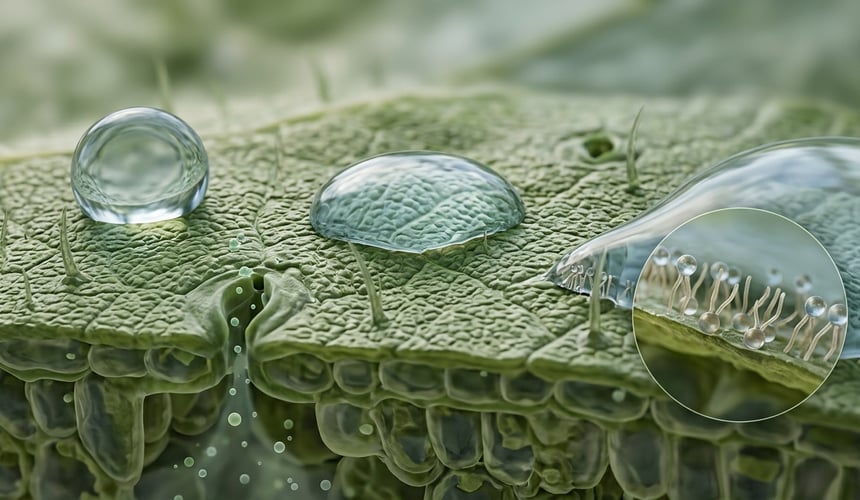
What determines whether a foliar-applied ingredient can effectively enter a plant leaf, and how do different surfactants play a role in this process? The efficacy of foliar-applied nutrients largely depends on their ability to move from the leaf surface into the plant's internal tissues. This journey involves overcoming the leaf's natural protective barriers, primarily the cuticle, which is designed to prevent water loss and the entry of harmful agents. Surfactants, key raw materials in many agricultural formulations, are integrated to modulate these interactions, influencing how effectively nutrients adhere, spread, and ultimately penetrate the leaf surface.
Cropenta Insight
Selecting the appropriate surfactant as a raw material for fertilizer and biostimulant formulations is critical for optimizing foliar nutrient delivery. Beyond merely reducing surface tension, specific surfactant types can interact differently with the leaf cuticle and the nutrient solution, influencing adhesion, spreading, and penetration pathways. Understanding these distinct mechanisms allows formulators to develop more targeted and efficient products for various crop and environmental conditions, ensuring better resource utilization and ultimately enhancing the overall efficacy of foliar applications.
Understanding Foliar Uptake Mechanisms
Foliar uptake of nutrients involves their passage through the leaf cuticle and, to a lesser extent, stomata. The cuticle, a waxy layer on the leaf surface, presents a primary barrier to external substances . It consists of cutin impregnated and covered by waxes, forming a hydrophobic layer that limits water and solute movement. However, the cuticle is not entirely impermeable; it contains polar pathways, often referred to as aqueous pores, which can facilitate the entry of hydrophilic compounds [1]. Stomata, microscopic pores primarily involved in gas exchange, also serve as potential entry points, particularly when they are open. The effectiveness of foliar uptake surfactants is largely determined by their ability to overcome these barriers, influencing the physical properties of the spray solution on the leaf surface.
Surfactant Classes and Their Influence
Surfactants are crucial adjuvants in foliar formulations, working to modify the physical properties of spray solutions to facilitate nutrient penetration . They are broadly classified into ionic (anionic, cationic), non-ionic, and amphoteric types, each exhibiting distinct behaviors in aqueous solutions and on plant surfaces. Non-ionic surfactants, for instance, are widely used due to their compatibility with various nutrient formulations and their ability to reduce surface tension effectively, promoting better spreading of droplets on the hydrophobic leaf cuticle [2]. This improved spreading helps maximize the contact area between the nutrient solution and the leaf surface, which is a prerequisite for subsequent absorption. Ionic surfactants, while also reducing surface tension, carry a charge that can influence their interaction with the cuticle's own surface charge and the nutrient ions in the solution, potentially affecting adhesion and penetration dynamics differently.
Beyond Wetting: Cuticular Permeability and Adhesion
While reducing surface tension and enhancing droplet spreading are primary functions of many foliar uptake surfactants, their influence extends to modifying the permeability of the plant cuticle itself. Some surfactants can interact with the epicuticular waxes, potentially disrupting their structure and creating more pathways for hydrophilic nutrients to enter [1]. This interaction is complex and depends on the specific chemical structure of the surfactant and the plant species' cuticle composition. Furthermore, surfactants play a role in maintaining the nutrient solution in a liquid state on the leaf surface for a longer duration, a phenomenon sometimes supported by hygroscopic agents that prolong the window for absorption [3]. Effective adhesion ensures that the nutrient solution remains on the leaf long enough for absorption to occur, rather than simply running off.
Conclusion for Effective Nutrient Delivery
Ultimately, selecting the optimal surfactant for foliar nutrient applications goes beyond general wetting properties. It requires an understanding of how specific surfactant types, as raw materials in formulations, interact with both the nutrient solution and the complex architecture of the plant leaf. Different ionic and non-ionic characteristics influence spreading, adhesion, and cuticular permeability, thereby modulating nutrient entry into the plant. This detailed consideration is vital for formulators aiming to develop effective foliar products that maximize nutrient absorption and contribute to efficient crop nutrition strategies.
Technical Summary
Foliar nutrient uptake relies on effective penetration of the plant cuticle. Surfactants, key raw materials in formulations, influence this by reducing surface tension and enhancing droplet spread. Beyond wetting, their specific ionic or non-ionic properties modulate cuticular permeability and solution adhesion. Understanding these distinct mechanisms allows for targeted selection of surfactants, optimizing nutrient delivery and absorption efficiency across diverse foliar applications.
Disclaimer
This article has been prepared with AI assistance using publicly available sources and is intended solely for general technical and educational purposes. It does not constitute professional advice or recommendations for specific applications. Cropenta makes no warranties regarding the accuracy, completeness or applicability of the information. No rights may be derived from its contents, and Cropenta accepts no liability for its use to the extent permitted by law.
Technical Questions
Do all surfactants enhance nutrient uptake equally?
No, surfactant efficacy varies significantly based on their chemical structure, concentration, the specific nutrient, target crop species, and environmental conditions. Different surfactant types interact uniquely with the leaf cuticle and the nutrient solution, leading to varied levels of spreading, adhesion, and penetration through cuticular or stomatal pathways.
How does the plant cuticle's composition affect surfactant efficacy?
The plant cuticle's composition, particularly its wax content and chemical nature, greatly influences how surfactants interact with the leaf surface. A thicker or more hydrophobic wax layer may require different surfactant properties for effective spreading and penetration. Surfactants can interact with these waxes, temporarily modifying their barrier properties to facilitate nutrient entry.
What role does solution pH play in surfactant performance for foliar application?
Solution pH can influence the stability and performance of certain surfactants, especially ionic types, as their charge may change with pH. It can also affect the solubility and plant availability of specific nutrients. Maintaining an optimal pH range for the entire formulation is important to ensure both surfactant efficacy and nutrient stability on the leaf surface.
Are there differences between synthetic and biosurfactants in foliar application?
Yes, synthetic and biosurfactants differ in their origin and chemical properties. Biosurfactants, derived from microorganisms, are often biodegradable and may have different interactions with the plant surface and nutrient solutions compared to synthetic counterparts. Both types aim to improve wetting and penetration, but their specific modes of action and environmental profiles can vary.
Related articles


Related Products


Looking for something specific?
Our team is there to help you find the right raw materials and solutions for your formulations

