Impact of Maillard Reactions on Lysine Availability in Overheated Soybeans
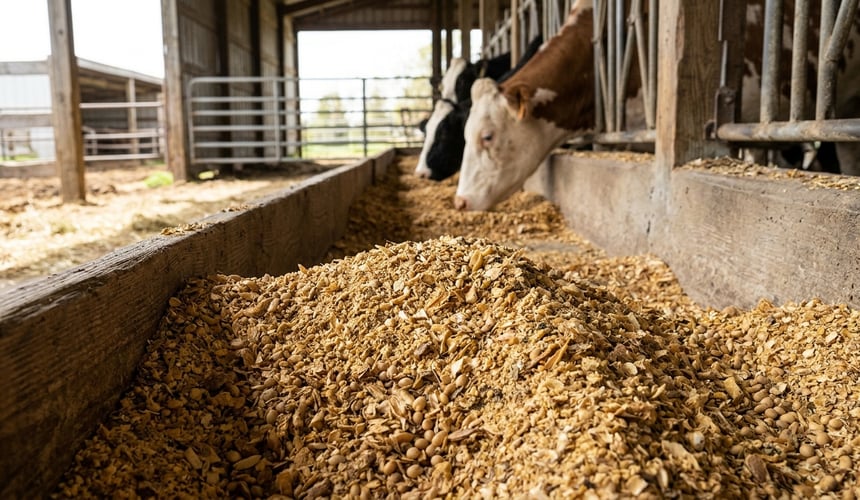
When full-fat soybeans are subjected to excessive heat treatment during processing, a non-enzymatic reaction between proteins and sugars, known as the Maillard reaction, can occur. This reaction alters the nutritional profile, particularly affecting the availability of essential amino acids like lysine. Understanding the chemical mechanisms and nutritional consequences of Maillard reactions on reactive lysine availability and overall protein digestibility is crucial for assessing and mitigating heat damage in processed full-fat soybeans.
Cropenta Insight
Processors of full-fat soybeans for feed must carefully control heat treatment to avoid Maillard reactions, which deplete available lysine and compromise protein quality. For formulators, relying solely on total protein content can mask significant nutritional damage. A precise evaluation of processing history and its effect on reactive lysine helps optimize protein utilization in animal diets and supports informed ingredient selection.
Chemical Mechanisms of Maillard Reactions and Lysine Damage
Maillard reactions involve a complex series of chemical steps, beginning with the condensation of a reducing sugar (such as glucose or fructose, which have free aldehyde or ketone groups) with a free amino group from a protein or amino acid. In soybeans, the epsilon-amino group of lysine is particularly susceptible due to its accessible structure. This initial reaction forms a Schiff base, which then rearranges into more stable Amadori products [1, 2]. These early Maillard products are often colorless but can progress through further reactions, including Strecker degradation, to form advanced Maillard reaction products (AMRPs) and brown nitrogenous polymers known as melanoidins [1]. While Maillard reactions can contribute to flavor, aroma, and color in some food products [1, 2], excessive heating can lead to a significant reduction in the nutritional value of feed ingredients, often described as “heat-damaged” [3].
The critical nutritional consequence of Maillard reactions is the binding of reactive lysine. Although the total lysine content measured chemically may remain unchanged, the lysine involved in Maillard adducts is no longer available for digestion and absorption by the animal [4]. This reduction in reactive lysine directly impacts the protein quality of soybeans, as lysine is often the first limiting amino acid in monogastric animal diets.
Nutritional Consequences for Processed Full-Fat Soybeans
Processing methods for full-fat soybeans, such as toasting, extrusion, or roasting, involve thermal treatment. Toasting, for example, uses heat (steam or dry heat) to reduce heat-labile anti-nutritional factors like trypsin inhibitors. However, if not carefully controlled, excessive toasting can initiate detrimental Maillard reactions. Extrusion, a thermomechanical treatment involving temperature, moisture, pressure, and shear forces, also carries the risk of over-processing if parameters are not precisely managed. Similarly, roasting, a dry heat treatment, can also induce Maillard reactions if not controlled.
The primary nutritional consequence of excessive heat treatment and resulting Maillard reactions in full-fat soybeans is a decrease in amino acid digestibility, particularly for lysine . Studies indicate that heat damage in soybean ingredients reduces reactive lysine and can negatively affect the growth performance of pigs [4]. While the overall protein content might appear adequate, the animal cannot efficiently utilize the bound amino acids, leading to an effective reduction in metabolizable protein and available energy. Therefore, indicators that measure the extent of heat treatment are crucial.
Various indicators are used to assess the quality of processed soybeans: trypsin inhibitor activity (TIA) measures residual anti-nutritional factors and is a direct indicator of adequate heat treatment for monogastrics. Urease activity (pH rise test) is an indirect indicator, showing that heat was applied but not necessarily optimal processing. KOH protein solubility and Protein Dispersibility Index (PDI) are other heat-treatment indicators that can reveal over-processing when values fall too low or under-processing when too high. However, reactive lysine determination and in-vivo amino acid digestibility measurements offer the most direct evaluation of amino acid availability for the animal [4]. These direct measures are essential because total lysine analysis alone does not differentiate between available and bound lysine.
Mitigating Heat Damage and Assessing Protein Quality
To mitigate the impact of Maillard reactions, precise control over heat treatment parameters during soybean processing is essential. This involves optimizing temperature, time, and moisture content for processes like toasting, extrusion, and roasting to effectively reduce anti-nutritional factors without causing significant protein damage. For example, full-fat toasted soybeans are processed to a specific moisture content to ensure optimal reduction of anti-nutritional factors and good oil availability, according to product documentation [5]. According to product documentation for full-fat toasted extruded soybeans, the process is designed to reduce anti-nutritional factors by heat treatment, and independent digestibility studies for pigs showed standardized ileal amino acid digestibilities similar to toasted soybeans [6].
Formulators should consider reactive lysine assays as a more accurate measure of lysine availability compared to total lysine content, especially when suspecting heat damage. While supplementation with crystalline lysine can help compensate for reduced reactive lysine [4], preventing damage through controlled processing is the most effective strategy. This comprehensive understanding of Maillard reactions and their specific impact on lysine allows for more accurate nutritional evaluations and informed decisions in animal feed formulation, moving beyond general concepts of protein degradation.
Technical Summary
Maillard reactions, initiated by excessive heat during soybean processing, chemically bind the epsilon-amino group of lysine, forming indigestible adducts. This significantly reduces reactive lysine availability and overall protein digestibility, despite unchanged total lysine content. Accurate assessment requires methods like reactive lysine analysis or in-vivo amino acid digestibility, which are more precise than indirect indicators, to prevent compromised animal performance and inform effective feed formulation strategies.
Disclaimer
This article has been prepared with AI assistance using publicly available sources and is intended solely for general technical and educational purposes. It does not constitute professional advice or recommendations for specific applications. Cropenta makes no warranties regarding the accuracy, completeness or applicability of the information. No rights may be derived from its contents, and Cropenta accepts no liability for its use to the extent permitted by law.
Technical Questions
How do Maillard reactions specifically affect the nutritional value of soybean protein beyond general protein denaturation?
Maillard reactions specifically bind the free epsilon-amino group of lysine, making it nutritionally unavailable even if the protein remains structurally intact or denatured. This is distinct from general protein denaturation, which primarily alters tertiary and secondary structures. The bound lysine cannot be released by digestive enzymes, directly reducing the bioavailability of this essential amino acid.
What is the primary limitation of relying solely on total lysine analysis when assessing heat-treated soybeans?
The primary limitation is that total lysine analysis measures all lysine, including that which has reacted in Maillard products and is nutritionally unavailable. It does not distinguish between reactive (digestible) and non-reactive (bound) lysine. Therefore, a high total lysine value can mask significant heat damage and an actual reduction in the amino acid usable by the animal.
How can process control during soybean toasting or extrusion help minimize Maillard reactions?
Minimizing Maillard reactions during toasting or extrusion relies on precise control of temperature, residence time, and moisture content. Avoiding excessive temperatures and prolonged exposure to heat, especially in the presence of reducing sugars, is critical. Careful monitoring of established indicators like urease activity, KOH protein solubility, and reactive lysine assays helps optimize processing to preserve amino acid availability.
- 1.Immunomodulation by Processed Animal Feed - PMC
- 2.Food Processing and Maillard Reaction Products: Effect on ...
- 3.Quantification of Maillard reaction products in animal feed
- 4.Effects of heat damage and crystalline amino acid ...
- 5.Cropenta product documentation: Full-Fat Toasted Soybeans
- 6.Cropenta product documentation: Full-Fat Toasted Extruded Soybeans
Related articles


Related Products

Looking for something specific?
Our team is there to help you find the right raw materials and solutions for your formulations

