Why Intestinal Digestibility Matters for Rumen-Protected Rapeseed Protein
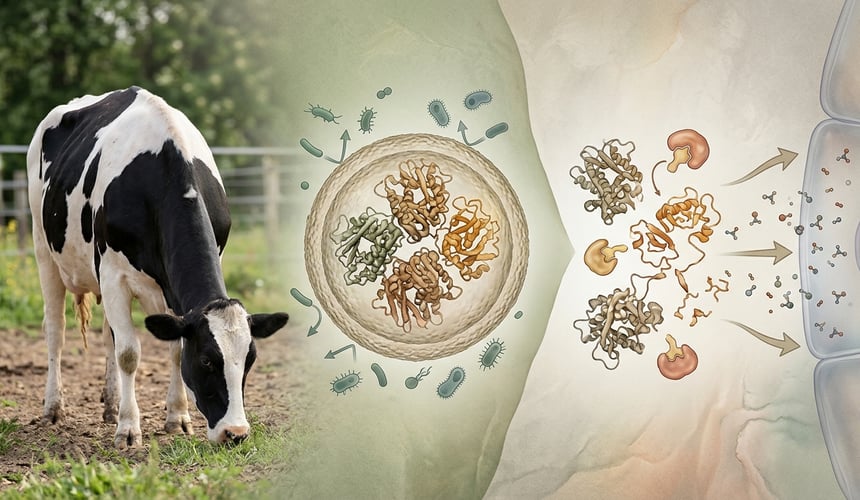
When formulating ruminant diets, nutritionists often focus on rumen-undegradable protein (RUP) to ensure sufficient amino acid supply beyond what microbial protein synthesis provides. However, merely protecting protein from rumen degradation is only part of the challenge. The crucial question is: Beyond how much protein bypasses the rumen, how well does that protected rapeseed protein actually get digested and absorbed in the animal's small intestine, and why is this so important for effective nutrient delivery?
Cropenta Insight
Understanding the interplay between rumen protection and intestinal digestibility is vital for evaluating protein ingredients. While high RUP values are a key factor, the ultimate nutritional impact depends on how efficiently the protected protein's amino acids are absorbed post-rumen. This integrated approach helps formulators optimize protein utilization by carefully matching ingredient characteristics to the specific needs of various ruminant applications, thereby enhancing nutrient delivery and animal performance.
The Dual Role of Rumen Protection and Intestinal Digestibility
Ruminants require a balanced supply of protein: rumen-degradable protein (RDP) to support microbial protein synthesis, and RUP (bypass protein) that escapes degradation in the rumen and is subsequently digested in the small intestine. Rapeseed meal is a valuable protein source for ruminants, offering a favorable amino acid profile. However, increased RUP alone does not guarantee nutritional effectiveness. If the rumen-protected protein is not well digested in the small intestine, its amino acids will not be available for absorption and utilization by the animal.
Intestinal digestibility refers to the proportion of the RUP that is actually broken down by enzymes in the abomasum and small intestine and absorbed into the bloodstream. A high RUP value combined with low intestinal digestibility means that a significant portion of the bypass protein passes through the digestive tract undigested, leading to inefficient nutrient utilization and economic loss. According to research findings, both rumen protection and intestinal digestibility are critical parameters for evaluating the true nutritional value of rumen-protected rapeseed protein [1, 2].
Measuring Intestinal Digestibility of Rapeseed Protein
According to research, the intestinal digestibility of rumen-undegraded protein is typically measured using in-vivo methods, such as the mobile nylon bag technique in cows fitted with duodenal cannulas [1, 2]. This technique involves incubating samples of the protein source in nylon bags within the rumen of fistulated cows to determine rumen degradation kinetics. After ruminal incubation, the bags are transferred to the duodenum (the first part of the small intestine) of cows with duodenal cannulas to measure post-ruminal digestion. This provides a direct measure of how much of the rumen-undegraded protein is actually digested and potentially absorbed in the small intestine [2].
An alternative approach involves enzymatic in vitro procedures (EIVP) to estimate intestinal crude protein digestibility of ruminally undegraded crude protein [3]. However, according to certain studies, in-vitro methods, particularly for Maillard-protected proteins, may tend to overstate rumen protection compared to in-vivo measurements and often correlate poorly with in-situ results [1].
Research by Wang et al. (2015) focused on estimating the rumen degradability and small intestinal digestibility of amino acids in various protein sources, including rapeseed meal [2]. This study highlighted the importance of amino acid-specific digestibility, as different amino acids may have varying intestinal digestion rates even within the same protein source. For example, according to product documentation for Bypass Rapeseed MP, a rumen-protected protein made from rapeseed meal and treated molasses, an intestinal digestibility of the rumen-undegraded protein of approximately 90% is reported [1].
Factors Influencing Intestinal Digestibility
Several factors can influence the intestinal digestibility of rumen-protected rapeseed protein:
- Processing Method and Intensity: The method and intensity of protein protection treatment can significantly impact intestinal digestibility. While controlled heat treatment or Maillard reactions can increase RUP, over-processing can lead to reduced intestinal digestibility by forming indigestible complexes.
- Amino Acid Profile: The specific amino acid composition of the rapeseed protein, and how individual amino acids are affected by protection treatments, can influence overall digestibility. Some amino acids may be more susceptible to damage during processing, potentially reducing their intestinal availability [2].
- Anti-nutritional Factors: Rapeseed meal naturally contains certain anti-nutritional factors. While modern varieties have significantly reduced glucosinolate content, their residual presence or the presence of other compounds might, in some cases, interfere with digestion, although this is less of a concern for highly processed, protected proteins [2].
- Physical Structure: The physical form and particle size of the protected rapeseed protein may also play a role in enzyme accessibility in the small intestine, potentially affecting digestion rates.
Studies have shown that while a high RUP percentage is desirable, it must be evaluated together with intestinal digestibility. For instance, some physically or lignosulfonate-treated rapeseed meals have shown RUP values in in-situ measurements that were lower than declared and, importantly, did not significantly improve milk protein output or feed nitrogen efficiency in feeding trials compared to untreated rapeseed meal [4]. This underscores that effective protein protection needs to translate into usable amino acids in the small intestine.
Nutritional Valuation and Formulation Relevance
Nutritional protein valuation systems, such as the Dutch DVE/OEB system, the German nXP/RNB system, or the CNCPS metabolizable protein system, account for both rumen degradation and intestinal digestibility when calculating feed formulation values. These systems translate measured degradation and digestibility characteristics into values that nutritionists use to balance diets.
Understanding the interplay between RUP and intestinal digestibility allows formulators to optimize amino acid delivery to ruminants. By selecting rumen-protected rapeseed protein ingredients with high intestinal digestibility, nutritionists can contribute to meeting the animal's amino acid requirements more efficiently, which supports various physiological functions without excessive nitrogen excretion.
Conclusion
The nutritional effectiveness of rumen-protected rapeseed protein in ruminant diets extends beyond its ability to bypass the rumen. Intestinal digestibility is an equally critical factor, determining how much of that protected protein is actually digested and absorbed as amino acids in the small intestine. Evaluating both RUP and intestinal digestibility, preferably through robust in-vivo methods, provides a comprehensive understanding of the ingredient's true value. This dual assessment allows for more precise dietary formulations that support optimal amino acid supply and overall protein efficiency in ruminants.
Technical Summary
Intestinal digestibility is a key determinant of the true nutritional value of rumen-protected rapeseed protein in ruminant diets, complementing rumen undegradable protein (RUP). In-vivo methods, such as the mobile nylon bag technique, measure the proportion of RUP digested in the small intestine. Processing intensity, amino acid profile, and anti-nutritional factors can influence this digestibility. High intestinal digestibility ensures efficient amino acid absorption, contributing to metabolizable protein supply and optimizing protein efficiency in ruminant rations.
Disclaimer
This article has been prepared with AI assistance using publicly available sources and is intended solely for general technical and educational purposes. It does not constitute professional advice or recommendations for specific applications. Cropenta makes no warranties regarding the accuracy, completeness or applicability of the information. No rights may be derived from its contents, and Cropenta accepts no liability for its use to the extent permitted by law.
Technical Questions
How do processing methods influence the intestinal digestibility of rumen-protected rapeseed protein?
The intensity and method of protein protection, such as heat treatment or Maillard reactions, directly influence intestinal digestibility. While controlled processing can increase rumen undegradable protein, over-processing may damage amino acids, particularly lysine, reducing their availability for digestion and absorption in the small intestine, leading to lower overall protein utilization.
Why are in-vivo methods preferred over in-vitro tests for measuring intestinal digestibility of protected proteins?
In-vivo methods, like the mobile nylon bag technique, provide a more accurate assessment of intestinal digestibility by simulating the complex digestive environment of the ruminant. In-vitro tests may not fully replicate these conditions and can sometimes overstate rumen protection or misrepresent actual amino acid availability compared to live animal measurements.
What is the relationship between rumen undegradable protein (RUP) and intestinal digestibility in protein valuation systems?
Nutritional protein valuation systems, such as the DVE/OEB or nXP/RNB systems, incorporate both RUP and intestinal digestibility to determine the metabolizable protein value of an ingredient. A high RUP value only translates to effective metabolizable protein if the rumen-undegraded portion is also highly digestible in the small intestine, providing usable amino acids to the animal.
Related articles


Looking for something specific?
Our team is there to help you find the right raw materials and solutions for your formulations

