How Seaweed Extracts Help Plants Cope with Ionic and Osmotic Stress under Salinity
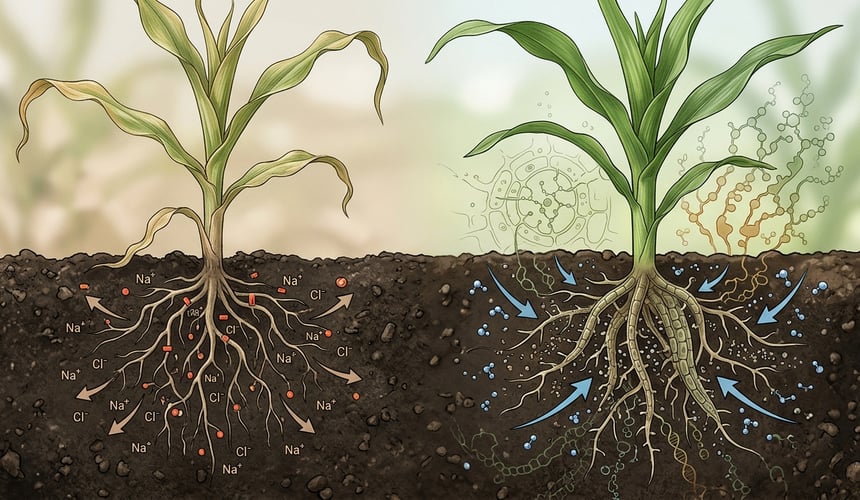
Plants cultivated in saline environments face a dual challenge: excessive salt ions lead to direct toxicity, while the altered external water potential causes osmotic stress. Understanding how specific interventions address these distinct pressures is crucial for enhancing crop resilience. Seaweed extracts, particularly those derived from brown algae like Ascophyllum nodosum, contain bioactive compounds that may help plants cope with these combined stressors by modulating physiological responses at the cellular level [1].
Cropenta Insight
The nuanced understanding of how seaweed extracts mitigate both ionic and osmotic stress is critical for professionals interpreting research findings. Recognizing that marine polysaccharides and osmoprotectants within these extracts act through distinct yet complementary pathways helps clarify their specific physiological roles. This distinction moves beyond general plant hardiness, offering a more precise view of their potential to support plant resilience under saline cultivation conditions for biostimulant manufacturers and agronomists.
Addressing Ionic Stress through Bioactive Compounds
Ionic stress primarily results from the accumulation of specific ions, such as sodium (Na+) and chloride (Cl-), to toxic levels within plant cells. This can disrupt enzyme activity, interfere with metabolic processes, and damage cell membranes. Seaweed extracts contain various compounds, including polyphenols and marine polysaccharides, that can influence a plant's ability to manage these toxic ions. For example, some components may support the plant's capacity for ion compartmentalization, where excess Na+ and Cl- ions are sequestered into vacuoles, thereby preventing them from interfering with metabolic functions in the cytoplasm [1]. This process helps maintain cellular integrity and function, even under conditions of high external salt concentrations.
Mitigating Osmotic Stress and Maintaining Water Balance
Osmotic stress, often a primary effect of salinity, occurs when high salt concentrations in the soil solution reduce the water potential, making it harder for roots to absorb water. This can lead to dehydration, reduced turgor, and impaired physiological processes. Seaweed extracts are rich in osmoprotectants like mannitol, a sugar alcohol, which can play a role in maintaining cellular water balance [1]. When absorbed by plants, these compounds may accumulate in the cytoplasm, helping to balance the osmotic pressure created by external salinity without interfering with metabolic activity. This osmotic adjustment allows plants to maintain turgor and continue essential physiological functions, such as photosynthesis and nutrient uptake, under water-limited conditions [2, 3].
Integrated Mechanisms for Enhanced Resilience
The benefit of seaweed extracts under salinity often stems from their ability to address both ionic and osmotic challenges simultaneously. Components such as alginates and fucoidans, which are types of marine polysaccharides, may influence cell wall properties and membrane permeability, potentially aiding in better water regulation and reduced ion uptake [1]. This integrated action means that seaweed extracts do not just provide a single solution, but rather a spectrum of physiological modulations. While the exact efficacy can depend on the seaweed species, extraction methods, and crop type, the dual mechanisms offer a nuanced perspective on how these biostimulants may support crop plants in saline environments [1, 4].
Technical Summary
Seaweed extracts offer specific physiological support to plants under salinity stress by mitigating both ionic toxicity and osmotic imbalance. Bioactive compounds like polyphenols and marine polysaccharides may aid in ion compartmentalization, while osmoprotectants such as mannitol help maintain cellular water potential. This dual action supports cellular function and turgor, contributing to plant resilience in challenging saline cultivation conditions.
Disclaimer
This article has been prepared with AI assistance using publicly available sources and is intended solely for general technical and educational purposes. It does not constitute professional advice or recommendations for specific applications. Cropenta makes no warranties regarding the accuracy, completeness or applicability of the information. No rights may be derived from its contents, and Cropenta accepts no liability for its use to the extent permitted by law.
Technical Questions
What is the primary difference between ionic and osmotic stress in plants under salinity?
Ionic stress arises from the direct toxicity of excessive salt ions, like sodium and chloride, accumulating within plant cells. Osmotic stress occurs when high external salt concentrations reduce water availability, making it difficult for plants to absorb water, leading to dehydration and reduced turgor. Both can severely impact plant growth and function.
How do marine polysaccharides in seaweed extracts contribute to salinity tolerance?
Marine polysaccharides, such as alginates and fucoidans found in seaweed extracts, may influence cell wall properties and membrane permeability. This can help regulate water uptake and potentially reduce the accumulation of toxic ions within plant cells, thus contributing to better water balance and overall cellular protection under saline conditions.
Can results from one seaweed species be generalized to all seaweed extracts?
No, the efficacy and specific mechanisms observed with one seaweed species, like Ascophyllum nodosum, may not universally apply to all other seaweed extracts. Compositional variability influenced by taxonomic origin and extraction methods can lead to differing bioactive compound profiles and, consequently, varied physiological effects in plants.
What role do osmoprotectants play when plants face salinity-induced osmotic stress?
Osmoprotectants, such as mannitol present in seaweed extracts, help plants maintain cellular water balance under osmotic stress. By accumulating in the cytoplasm, these compounds help balance the osmotic pressure caused by external salinity, allowing cells to retain water and maintain turgor without disrupting metabolic processes.
Related articles

Related Products



Looking for something specific?
Our team is there to help you find the right raw materials and solutions for your formulations

