Why Are Some Liquid Fertilizer Formulations Incompatible?
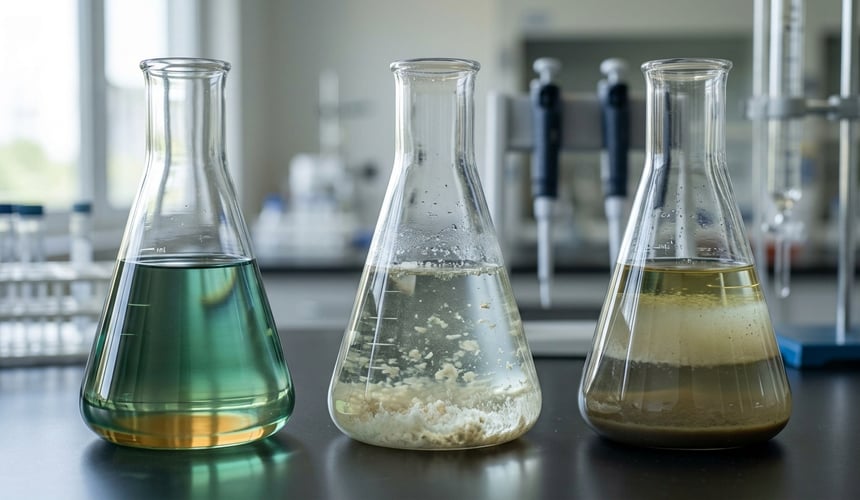
Liquid fertilizers and biostimulants offer efficient nutrient delivery, but their effectiveness hinges on formulation stability. Instability in these products can manifest as precipitation, crystallization, or phase separation, impacting their utility and agronomic performance. These issues often arise from specific chemical and physical interactions at the raw material level, challenging the development of stable liquid formulations.
Cropenta Insight
Understanding raw material characteristics, such as solubility and pH behavior, is critical for addressing liquid fertilizer incompatibility. Differences in raw material quality and water impurities can lead to unforeseen reactions, highlighting the need for careful formulation practices.
Factors Leading to Instability in Liquid Formulations
The stability of liquid fertilizer and biostimulant formulations can be influenced by several key factors. One significant aspect is the inherent chemical properties of the raw materials used. Different nutrient sources, organic acids, amino acids, and other biostimulant components each have distinct solubilities and reactivity profiles. For instance, some nutrient salts may have limited solubility, leading to precipitation if their concentration exceeds saturation limits or if interacting ions are present [1].
Another critical factor is the pH of the solution. The pH level dictates the speciation and reactivity of many components within a liquid formulation. Changes in pH can shift solubility equilibria, causing certain compounds to precipitate out of solution. For example, some metal ions form insoluble hydroxides at higher pH levels, while other nutrients may be less stable in acidic conditions. Maintaining an optimal pH range is often necessary to keep all components in a soluble and stable form [1].
Water quality also plays a substantial role in liquid fertilizer incompatibility. Impurities in water, such as bicarbonates, calcium, and magnesium ions, can react with components in the formulation, leading to unwanted precipitation. Hard water, in particular, can cause issues by forming insoluble salts with phosphates or sulfates, reducing nutrient availability and clogging application equipment. Careful consideration of water sources and, if necessary, water treatment, is a prerequisite for stable formulations [1].
Understanding Precipitation and Phase Separation
Precipitation occurs when dissolved substances form solid particles within the liquid, often due to exceeding solubility limits or chemical reactions that create insoluble compounds. This can lead to a loss of active ingredients, uneven nutrient distribution, and clogging of irrigation lines and spray nozzles [1]. Crystallization is a specific form of precipitation where solids form ordered crystalline structures, often influenced by temperature fluctuations or supersaturation.
Phase separation, on the other hand, involves the formation of distinct layers within the liquid formulation. This typically happens when components with differing polarities or densities fail to remain homogenously mixed. While not always involving solid formation, phase separation still indicates an unstable product, making it difficult to ensure consistent application of all ingredients [1]. For instance, some organic components in biostimulants may separate from inorganic nutrient solutions if appropriate emulsifiers or stabilizers are not included [2].
To mitigate these issues, formulators often employ strategies such as chelating agents to maintain metal ion solubility, pH buffers to stabilize the solution, and specific processing techniques to ensure homogeneity. The choice of raw materials, the order of mixing, and storage conditions all collectively influence the long-term stability of liquid fertilizer and biostimulant products [3, 4].
Considerations for Amino Acid Formulations
Amino acid products, often used in biostimulant and fertilizer formulations, also require specific attention regarding compatibility. According to product documentation, amino acid raw materials can vary significantly in their composition depending on the source material and hydrolysis process. According to the supplier, enzymatic hydrolysis yields a product with L-amino acids and a broad profile, which may differ from acid-hydrolyzed materials that can contain D-amino acids [5].
According to the supplier, when mixing amino acids, it is generally recommended to prepare the diluted fertilizer or crop-input solution first, measure its pH and electrical conductivity (EC), and then add the amino acids last.
Technical Summary
Incompatibility in liquid fertilizer formulations, manifesting as precipitation, crystallization, or phase separation, arises from raw material properties, pH fluctuations, and water impurities. Maintaining optimal pH, using appropriate raw materials, and addressing water quality are key to stability. For amino acid formulations, raw material quality and cautious mixing practices, particularly with calcium or magnesium-rich solutions, are vital to prevent issues.
Disclaimer
This article has been prepared with AI assistance using publicly available sources and is intended solely for general technical and educational purposes. It does not constitute professional advice or recommendations for specific applications. Cropenta makes no warranties regarding the accuracy, completeness or applicability of the information. No rights may be derived from its contents, and Cropenta accepts no liability for its use to the extent permitted by law.
Technical Questions
What role does water quality play in liquid fertilizer incompatibility?
Water quality significantly influences liquid fertilizer stability. Impurities like bicarbonates, calcium, and magnesium ions in hard water can react with formulation components. These reactions often lead to the formation of insoluble salts, causing precipitation. Such issues can reduce nutrient availability and potentially clog irrigation systems or spray nozzles, underscoring the need for careful water management in liquid fertilizer production.
How do pH levels affect the stability of liquid fertilizer formulations?
The pH level is a critical determinant of liquid fertilizer stability, as it affects the solubility and speciation of various components. A change in pH can alter solubility equilibria, leading to precipitation of certain compounds. For instance, some metal ions may form insoluble hydroxides at higher pH, while others are less stable in acidic conditions. Maintaining an optimal pH range is crucial for keeping all ingredients dissolved.
What is the difference between precipitation and phase separation in liquid fertilizers?
Precipitation involves the formation of solid particles from dissolved substances within a liquid, often due to exceeding solubility limits or chemical reactions. Phase separation, conversely, is the formation of distinct liquid layers, typically when components with different polarities or densities fail to mix homogenously. Both indicate instability, but precipitation creates solids, while phase separation results in separate liquid phases.
What factors should be considered when selecting an amino acid supplier for OEM fertilizer products?
When selecting an amino acid supplier for OEM fertilizer products, key considerations include the raw material origin (e.g., plant or animal), the hydrolysis process (enzymatic versus acid), and the resulting amino acid profile. According to the supplier, products vary in salt content, heavy-metal levels, and the proportion of L-amino acids, which plants primarily utilize. These factors influence overall product quality, stability, and potential phytotoxicity.
- 1.Food Waste–Derived Organic Fertilizers: Critical Insights ...
- 2.Liquid organic fertilizers in soilless cultivation: a systematic ...
- 3.Controlled-Release Fertilizers: Innovations, Challenges ...
- 4.Review of research and innovation on novel fertilizers for ...
- 5.Cropenta product documentation: Amino Peptide Basic Plus
Related articles
Related Products




Looking for something specific?
Our team is there to help you find the right raw materials and solutions for your formulations

