How Fatty Acid Composition Influences Energy Value of Extruded Full-Fat Soybeans
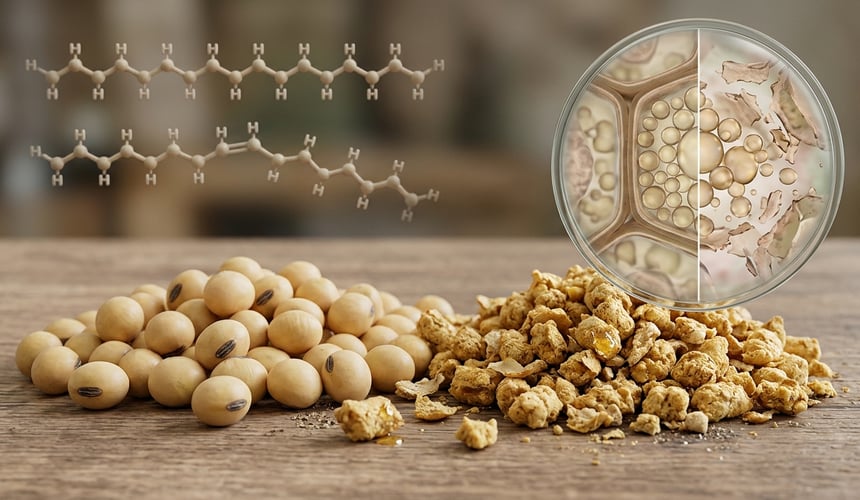
Two samples of extruded full-fat soybeans can carry the same crude fat figure and still deliver different amounts of usable energy. The reason usually sits in the fatty acid composition: how much of the oil is oleic acid, how much is linoleic acid, and how much is saturated. Fatty acid composition influences the energy value of extruded full-fat soybeans, and it does so through digestibility, absorption efficiency and the way the oil is physically released from the bean matrix during extrusion.
Cropenta Insight
Extruded full-fat soybeans differ from solvent-extracted soybean meal because the oil remains within the bean structure, and this oil is generally characterized by high levels of unsaturation. For nutritionists evaluating energy content, the fatty acid profile is not a fixed constant; factors such as bean variety, growing conditions and extrusion parameters can shift this balance. Fatty acid composition is therefore a relevant input when interpreting energy values, alongside processing indicators.
Why Fatty Acid Composition Matters More Than Crude Fat
Crude fat provides a measure of the total oil present, but it does not detail the specific composition of that oil. Soybean oil typically includes approximately 11% palmitic acid and 4% stearic acid, with the remainder largely unsaturated, where linoleic and oleic acids are dominant[1].
This structural alteration does not inherently confirm higher digestibility. Rather, it modifies the location and rate of oil availability, and its impact is linked to the fatty acid profile: unsaturated fatty acids may experience greater benefit from improved physical release because of their inherent emulsification characteristics. Furthermore, extrusion processes can reduce anti-nutritional factors such as trypsin inhibitors, although the degree of this reduction depends on the specific process conditions employed rather than on the term used to describe the process.
What Extrusion Does to Oil Availability
Extrusion combines heat, moisture and mechanical shear. The cell walls of the soybean are disrupted, and oil that was compartmentalized inside intact cells becomes more accessible to digestive enzymes. For a nutritionist, the practical consequence is that two extruded full-fat soybean batches with identical crude fat can differ in the fraction of oil that is physically available for hydrolysis and absorption.
Studies on extruded or roasted full-fat soybean meals indicate that processing route and conditions influence amino acid and energy digestibility[2, 3]. The direction and size of the difference depend on the starting material and the process settings, not on a general rule that one route is always superior.
Fatty Acid Profile as a Formulation Variable
Because monogastric animals digest unsaturated fatty acids more readily than saturated ones, the saturation balance contributes to the metabolizable energy density of the ingredient. A soybean batch with a higher oleic acid share and a lower linoleic acid share will not behave identically to a high-linoleic batch, even when crude fat is comparable. In poultry, the metabolizable energy response to extruded soybean meal with varying fat and oleic acid content has been evaluated directly[4].
For formulation, this means the fatty acid profile is not merely a labeling detail. It is a variable that interacts with inclusion rate, dietary energy targets and the oil already supplied by other ingredients. When energy is a major cost driver, verifying the profile of the actual incoming material is more useful than relying on a single book value.
Practical Reading of Processing and Composition Data
A workable approach combines three data streams. First, crude fat and moisture confirm the basic composition. Second, urease activity, trypsin inhibitor activity and KOH protein solubility give an indication of heat treatment and protein quality. Third, the fatty acid profile describes the oil itself. Taken together, these measurements describe the ingredient more completely than any single value.
Poultry data on full-fat soybean meals as an alternative feed ingredient show that the ingredient can be used in compound feed, provided the nutritional profile and processing quality are verified[1]. Species differences in digestive physiology mean that energy values derived in poultry should not be transferred directly to swine or aquaculture without species-specific data.
Technical Summary
Fatty acid composition is a core determinant of the energy value of extruded full-fat soybeans. Crude fat alone does not capture it, because saturation balance, oil release from disrupted cells and processing conditions all interact. For feed formulators, the practical takeaway is to treat the fatty acid profile as a routine specification alongside processing indicators, to confirm energy values with material-specific data where possible, and to avoid transferring energy values between species without supporting evidence.
This article was created with the help of AI and reviewed by the Cropenta editorial team. It is general information, not professional advice.
Technical Questions
How should formulators interpret urease and trypsin inhibitor activity in extruded full-fat soybeans?
Urease activity indicates the extent of heat application but does not confirm optimal processing. Trypsin inhibitor activity is a direct measure relevant for monogastrics, and parameters like KOH protein solubility or the Protein Dispersibility Index can indicate over-processing. For extruded full-fat soybeans, formulators should integrate these indicators with fatty acid profile data and, if available, ileal digestibility data.
Does extrusion change the fatty acid profile itself, or only its availability?
The fatty acid profile sets the inherent energy potential, while extrusion largely determines how much of that oil the animal can physically access. Because unsaturated fatty acids emulsify more easily, a bean high in these types may respond more to cell rupture caused by extrusion, compared with one having a high saturated fat content.
Can roasted full-fat soybeans be substituted for extruded ones at the same inclusion rate?
This substitution requires caution. Roasting and extrusion differ in heat transfer mechanisms, moisture levels and shear forces. Comparative studies suggest that the two processing routes do not result in identical nutritional outcomes, so they should not be treated as chemically equivalent raw materials without further specific analysis.
- 1.Full-Fat Soybean Meals as an Alternative Poultry Feed Ingredient—Processing and Quality Control Methods: A Review
- 2.Amino acids and energy digestibility in extruded or roasted full fat soybean fed to growing pigs
- 3.Amino acids and energy digestibility in extruded or roasted full fat soybean fed to growing pigs - PMC
- 4.Influence of extruded soybean meal with varying fat and oleic acid content on amino acid and energy digestibility in broilers
Looking for something specific?
Our team is there to help you find the right raw materials and solutions for your formulations